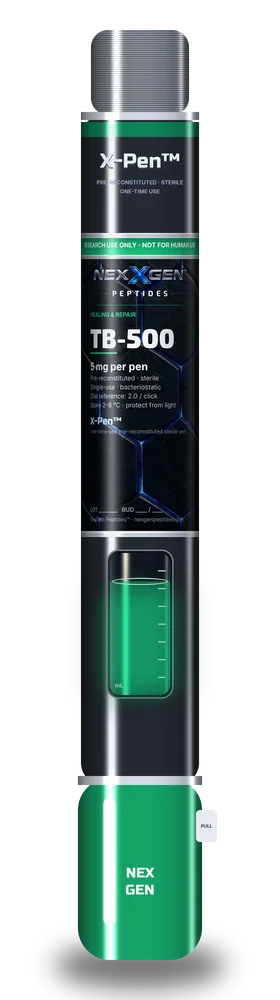
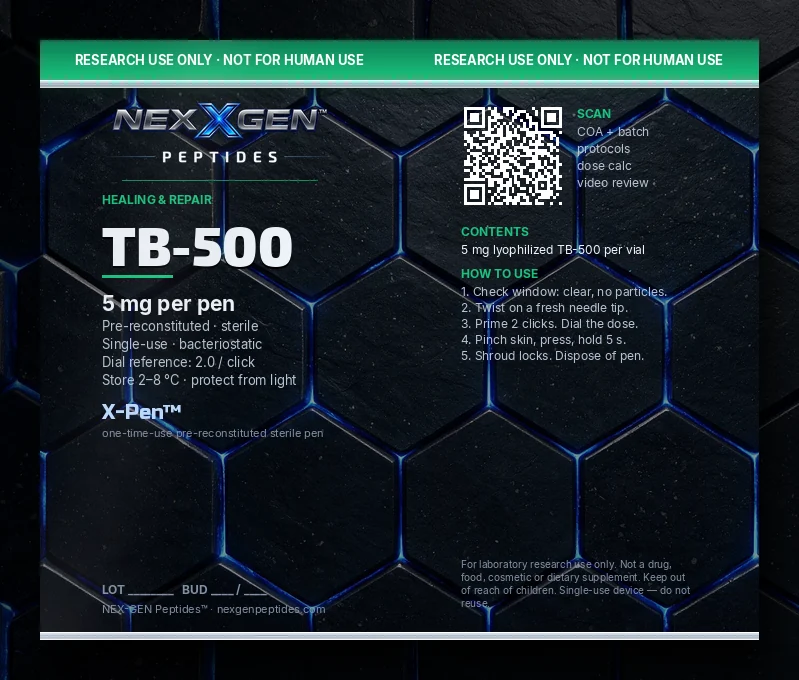
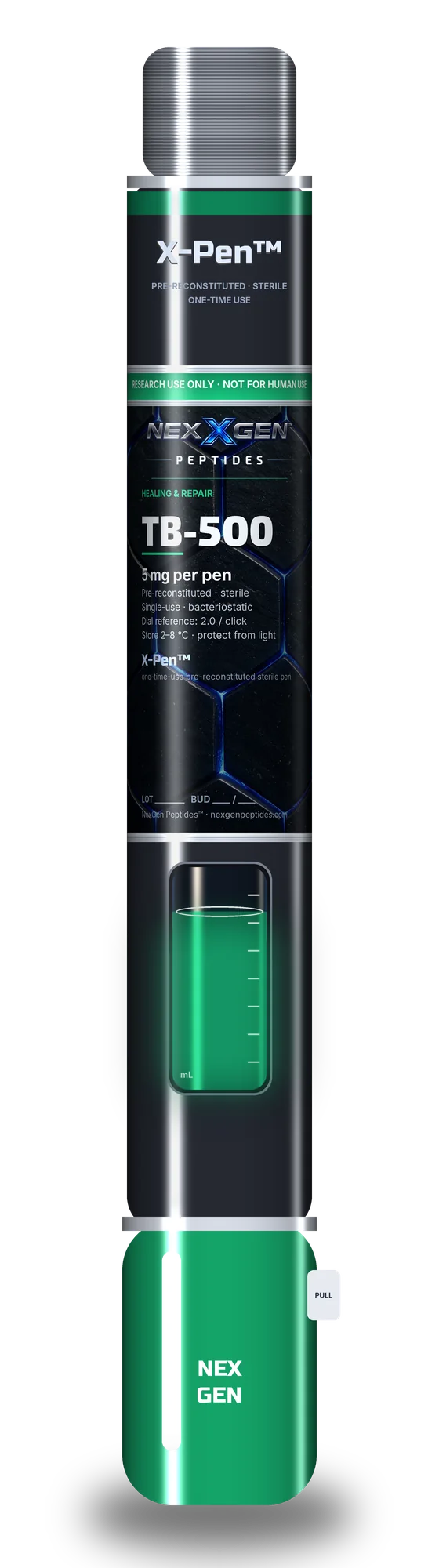
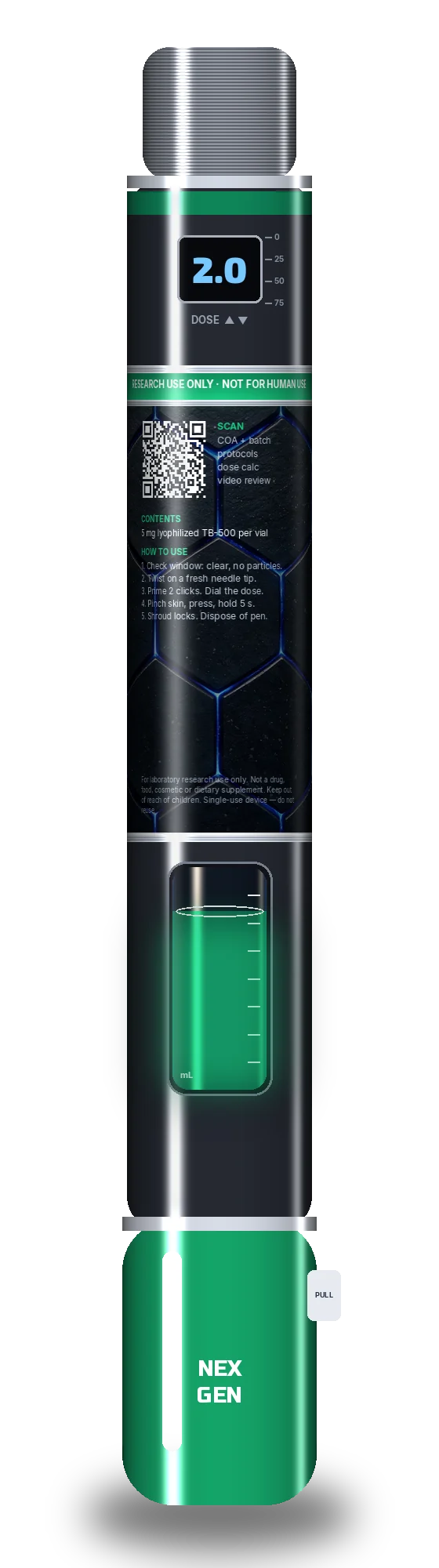
TB-500
Also known as: Thymosin Beta-4 fragment · TB4 · Tβ4 (17-23) fragment (oral)
A research peptide marketed as a thymosin beta-4 fragment and studied for cell migration, angiogenesis and tissue repair.
TB-500 is the name commonly used for a synthetic peptide marketed as a fragment of thymosin beta-4 (Tβ4), a naturally occurring 43-amino-acid protein involved in actin regulation and cell movement. The exact marketed TB-500 sequence and formulation can vary by supplier; “TB-4 fragment” may also refer to the short LKKTETQ region corresponding to residues 17–23 of thymosin beta-4. Full-length thymosin beta-4 research and clinical formulations should not be assumed to represent the same product as TB-500.
Research on full-length thymosin beta-4 includes laboratory and animal work on wound healing, corneal repair, cell migration and inflammation. Human studies have evaluated specific topical thymosin beta-4 formulations, including eye and wound applications, but those studies do not establish the efficacy or safety of injected TB-500. For the exact marketed fragment, evidence is largely preclinical and practitioner-reported. Research outcomes associated with full-length Tβ4 therefore cannot simply be transferred to TB-500 products.
In practitioner protocols, TB-500 is used systemically by subcutaneous injection, often as a loading phase followed by lower maintenance dosing. Jay Campbell’s reported protocol pairs it with BPC-157 in the Wolverine stack and emphasizes rotating injection sites rather than injecting directly into an injury. The Handbook includes injectable BPC-157/TB-500 as a tissue-repair pairing and also lists an oral TB-4 fragment among shorter peptides marketed for oral bioavailability. These approaches remain distinct from approved clinical wound-care products.
@SupplementGraveyard review
Subscribe to @SupplementGraveyard to catch it on release.
What it is studied for
Full-length thymosin beta-4 studies in animal wound models report faster wound closure and changes in epithelialization, collagen organization and repair-related cell activity.
Clinical research has studied topical full-length thymosin beta-4 eye formulations for ocular-surface conditions; these formulations and routes do not establish effects for injected TB-500.
Cell studies of thymosin beta-4 report actin-related cell migration and endothelial responses associated with formation of new vessels.
Practitioner protocols describe use during injury-recovery or heavy-training blocks, commonly alongside BPC-157; controlled human outcomes for injected TB-500 have not been established.
How it works
Thymosin beta-4 binds G-actin and regulates actin polymerization, a process that supports cell movement, tissue organization and wound repair. In full-length Tβ4 research, proposed downstream effects include endothelial-cell migration, angiogenesis, modulation of inflammatory mediators and support for keratinocyte and fibroblast activity. The short TB-500 fragment is marketed as retaining selected activity, but its pharmacology is not as well characterized as that of the full-length protein. A validated receptor-mediated mechanism for the commonly marketed TB-500 product has not been established; claims about specific outcomes often draw on broader Tβ4 research.
Protocols used in studies & practitioner literature
Informational only. These are protocols reported in published studies, product labels and practitioner references, listed so you can read the research intelligently. They are not dosing instructions. Injectable products on this site are research-use-only.
- Dose
- 2.0–2.5 mg per injection
- Frequency
- Subcutaneous twice weekly
- Timing
- No specific timing reported
- Cycle
- Loading phase for 4–6 weeks, followed by lower maintenance dosing; maintenance amount and duration vary
- Route
- Subcutaneous injection
- Dose
- 500 mcg daily
- Frequency
- Daily
- Timing
- No specific timing reported
- Cycle
- Used in some practitioner protocols; duration varies
- Route
- Subcutaneous injection
- Dose
- GHK-Cu:TB-500:BPC-157 in a 5:1:1 blend ratio (example blend: 50 mg:10 mg:10 mg)
- Frequency
- Protocol frequency varies by formulation
- Timing
- No specific timing reported
- Cycle
- Some guidance includes at least 15 days off between cycles
- Route
- Subcutaneous injection
When and how it is used
- Practitioner protocols describe subcutaneous dosing as systemic and advise rotating sites rather than injecting into the injury itself.
- Reported loading cycles range from 4–6 weeks; some practitioner guidance calls for at least 15 days off between cycles. Maintenance schedules vary and should not be inferred from a loading protocol.
- The Handbook’s oral TB-4 fragment discussion refers to a shorter fragment marketed for oral use; it is not equivalent to evidence for injectable TB-500 or full-length thymosin beta-4.
- Track pain, range of motion, training tolerance and clinician-guided rehabilitation progress. Do not use symptom changes to delay assessment of a serious injury.
- Injectable reconstitution and storage depend on the specific product and sterile preparation conditions. Do not improvise mixing, storage or injection procedures for a research-use product.
Synergies and stacks
Considerations and cautions
- Injectable TB-500 products sold by NexGenPeptides.com are research-use-only. The marketed fragment is not an FDA-approved medicine, and product identity and sequence may vary by supplier.
- Clinical findings from full-length thymosin beta-4 or topical ophthalmic formulations cannot be assumed to apply to subcutaneous TB-500. Human trials establishing dose, effectiveness and long-term safety for injected TB-500 are lacking.
- Potential immune reactions, interactions, pregnancy risks and long-term effects are not well characterized. Sterility, peptide identity and concentration are additional concerns with unregulated injectable products.
- Thymosin beta-4 and its derivatives are prohibited in sport by the World Anti-Doping Agency. Athletes subject to testing should avoid TB-500.
The Handbook take
The Handbook groups BPC-157 and TB-500 as a synergistic injectable tissue-repair pairing for partial tendon or ligament injuries, recovery and gut support. It also lists TB-4 fragment among oral peptides, describing the shorter fragment as a way to target oral bioavailability; that oral-fragment discussion is not the same as the injectable TB-500 protocol.
Frequently asked questions
What is a commonly reported TB-500 dose?
Jay Campbell’s practitioner protocol reports 2.0–2.5 mg subcutaneously twice weekly for 4–6 weeks, followed by lower maintenance dosing. Other practitioner protocols use 500 mcg daily.
How long does TB-500 take to work?
There is no reliable human timeline for injected TB-500. Practitioner loading phases are typically described as 4–6 weeks, but this schedule does not establish when or whether an individual will notice an effect.
What side effects can TB-500 cause?
Side-effect rates for injected TB-500 are not characterized in controlled human research. Unknown systemic effects, immune reactions and contamination or dosing errors are important concerns with unregulated injectable products.
Is oral TB-500 the same as injectable TB-500?
No. The Handbook’s oral discussion refers to a shorter TB-4 fragment; injectable TB-500 is marketed as a different preparation. Evidence for one formulation or route cannot be assumed to establish effects for the other.
Can TB-500 be combined with BPC-157?
Practitioner protocols commonly pair them in the Wolverine stack, and the Handbook lists the combination for tissue repair. Controlled human studies have not validated the combination’s benefits or safety.
Is TB-500 allowed in sport?
No. Thymosin beta-4 and its derivatives are prohibited by WADA. TB-500 is also sold as a research-use-only product rather than an approved medicine.
Sourcing
Related entries
Research supply
BioLongevity Labs products for laboratory research, available to buy now. BioLongevity Labs takes the order and ships it; these listings are separate from the educational material. Affiliate disclosure: BioLongevity Labs links and code JASONJOHNS (15% off eligible orders) are affiliate links and a paid code; NexGen may earn a commission at no extra cost to you if you buy through them.
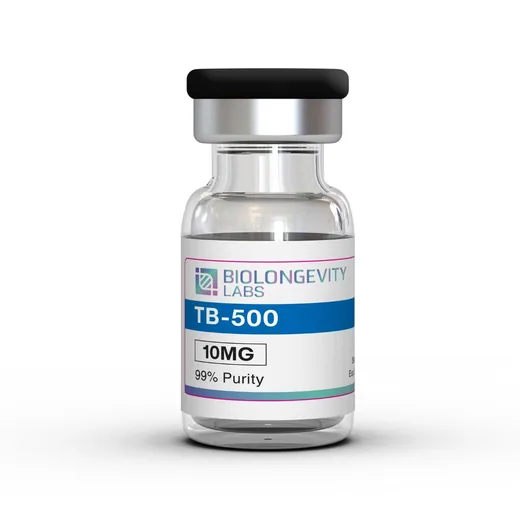
Research use only. Not for human consumption.
$64.97 as of Nov 22, 2026. Price at merchant may differ.
View research listingEducational content from an executive health coach, written as "what I would do if I were you" guidance — not medical advice, diagnosis or treatment. Injectable products sold on this site are for research use only and are not for human consumption. Talk with your licensed clinician before changing any protocol. Last reviewed November 2026.