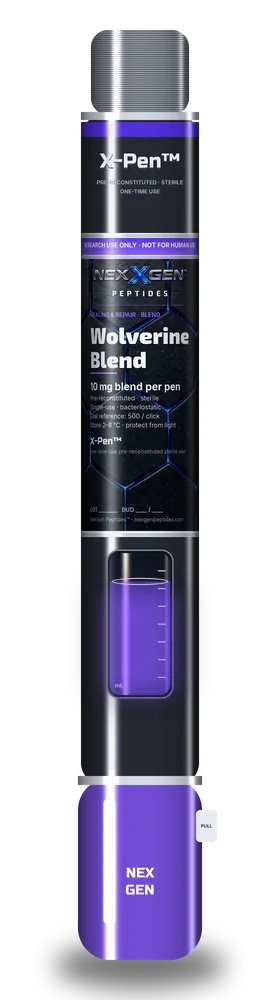
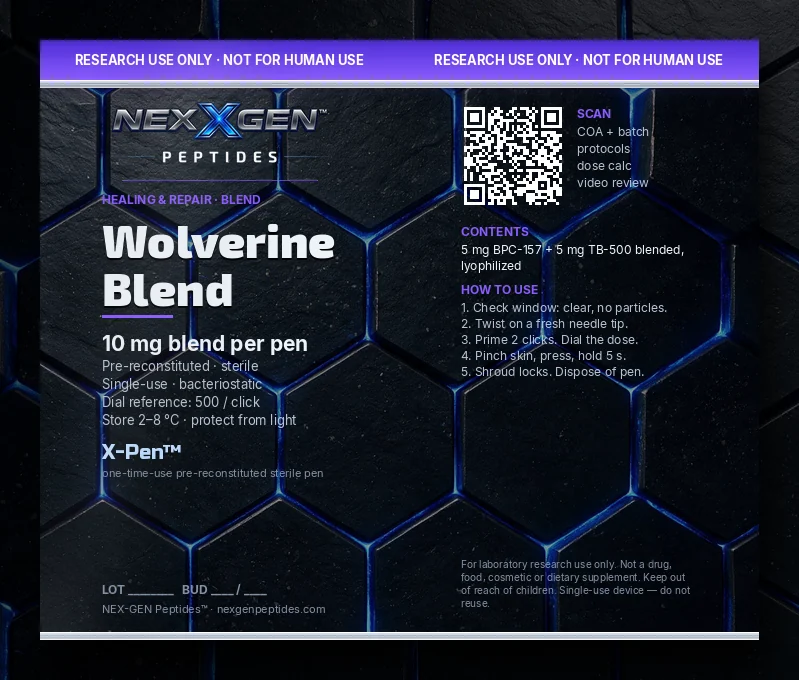
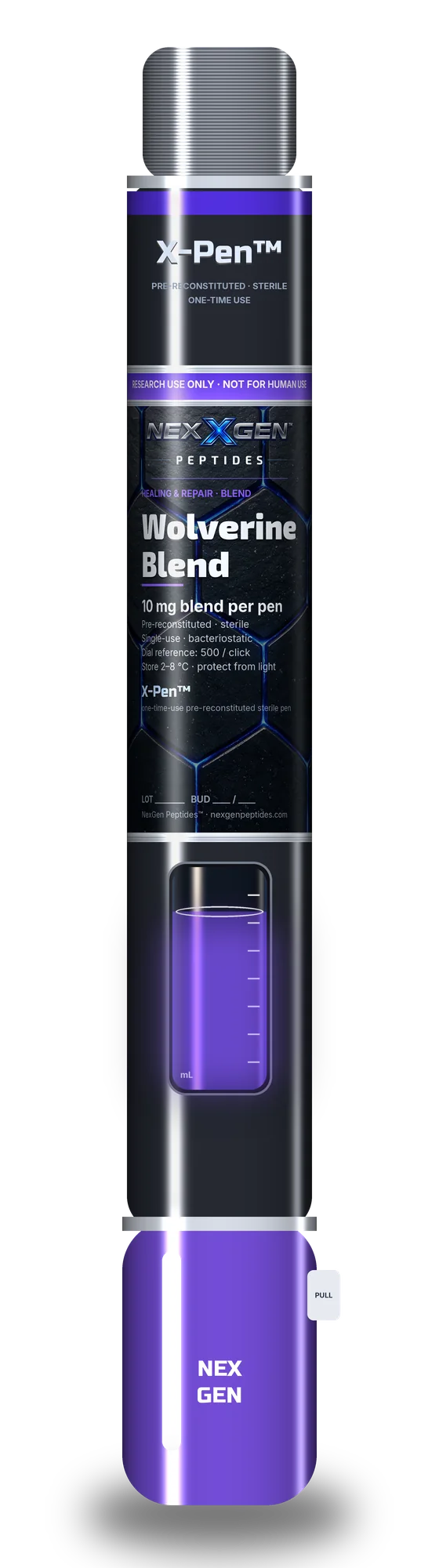
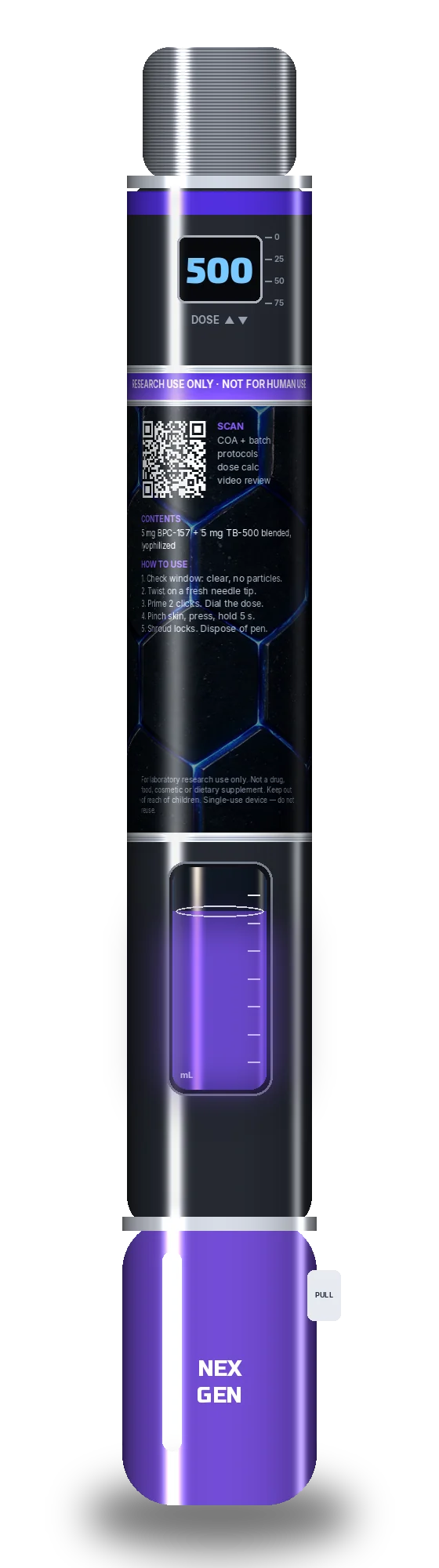
BPC-157 + TB-500 Blend
Also known as: Wolverine stack · Wolverine blend
A practitioner-used combination of BPC-157 and TB-500, commonly called the Wolverine stack, for tissue-repair protocols.
The BPC-157 + TB-500 blend combines two distinct peptides marketed for tissue repair: BPC-157, a synthetic 15-amino-acid peptide based on a gastric-protein sequence, and TB-500, a product name generally associated with a thymosin beta-4 fragment. A fixed blend is not a single molecule and does not have one shared structure or established pharmacology. Formulations vary; some practitioner variants add GHK-Cu or KPV and use names such as GLOW or KLOW. The blend is commonly called the Wolverine stack in practitioner literature.
The biological rationale draws mostly on separate animal and laboratory findings: BPC-157 studies examine gastrointestinal and musculoskeletal injury models, while thymosin beta-4 research examines actin regulation, cell migration and wound repair. There are no controlled human trials establishing the safety, optimal ratio or added benefit of the combined injectable stack. Results from full-length thymosin beta-4 research do not establish results for a TB-500 fragment, and findings from animal models do not establish clinical outcomes for the blend.
In practice, practitioners describe the blend for injury-recovery blocks, often with subcutaneous administration and a time-limited cycle. The Handbook lists BPC-157/TB-500 together for tissue repair, partial tendon or ligament tears, exercise recovery and gut support, and notes that complete tears may require surgery. Jay Campbell’s protocols provide several distinct schedules, including a BPC-157 plus twice-weekly TB-500 loading approach and a KLOW variant. These are reported protocols, not a standardized treatment regimen.
@SupplementGraveyard review
Subscribe to @SupplementGraveyard to catch it on release.
What it is studied for
The Handbook and practitioner protocols describe the pair for tissue-repair cycles; there are no controlled human trials establishing outcomes for the combined blend.
Separate animal studies of BPC-157 and full-length thymosin beta-4 report findings related to tissue repair, angiogenesis and cell migration; the studies do not test the commercial combination.
Laboratory research on thymosin beta-4 and BPC-157-related pathways examines cell movement, endothelial activity and signaling associated with repair, not a fixed commercial blend.
The Handbook frames the pairing as supporting gut healing and exercise recovery alongside soft-tissue repair; these uses have not been validated as blend-specific human outcomes.
How it works
The combination is proposed to engage complementary repair-related processes rather than a known blend-specific receptor. BPC-157 research describes changes in nitric-oxide signaling, VEGF-related angiogenesis, FAK-paxillin and ERK/Akt pathways, while thymosin beta-4 binds actin and supports cell migration. Together these effects are hypothesized to influence vascular response, fibroblast activity and tissue remodeling. The blend’s actual pharmacology depends on the identity, concentration and ratio of its ingredients, and no human study has demonstrated that the combined product produces a greater effect than either component alone.
Protocols used in studies & practitioner literature
Informational only. These are protocols reported in published studies, product labels and practitioner references, listed so you can read the research intelligently. They are not dosing instructions. Injectable products on this site are research-use-only.
- Dose
- BPC-157 250–500 mcg per injection plus TB-500 approximately 2–2.5 mg per injection
- Frequency
- BPC-157 subcutaneous dosing commonly 1–2 times daily; TB-500 twice weekly
- Timing
- No specific timing reported
- Cycle
- 4–8 weeks; some TB-500 loading schedules are 4–6 weeks
- Route
- Subcutaneous injection
- Dose
- BPC-157 250–500 mcg plus TB-500 500 mcg
- Frequency
- Some practitioner protocols use TB-500 daily; BPC-157 frequency varies
- Timing
- No specific timing reported
- Cycle
- 4–8 weeks in reported stack guidance
- Route
- Subcutaneous injection
- Dose
- 500 mcg per injection
- Frequency
- 5 days on, 2 days off
- Timing
- No specific timing reported
- Cycle
- 8 weeks on, 4 weeks off
- Route
- Subcutaneous injection
- Dose
- GHK-Cu:TB-500:BPC-157 ratio 5:1:1; example blended vial 50 mg:10 mg:10 mg
- Frequency
- Protocol frequency varies
- Timing
- No specific timing reported
- Cycle
- At least 15 days off between cycles in reported guidance
- Route
- Subcutaneous injection
When and how it is used
- The Handbook describes the combination as periodic and associated with injury, heavy training blocks or another protocol, rather than a permanent daily routine.
- The cited practitioner schedules differ in dose and frequency. They should be understood as separate reported approaches, not combined into a single schedule.
- Practitioner guidance describes subcutaneous dosing as systemic; the Jay Campbell protocol says injection directly into the injury is not required. Rotate sites if an injectable is used under qualified medical oversight.
- Track symptoms alongside clinician-directed function measures, rehabilitation milestones and activity tolerance. A peptide stack does not determine whether an injury is a partial or complete tear.
- Do not improvise reconstitution or combine separate research products. Product-specific sterility, concentration and storage instructions matter, and research-use products should not be self-administered.
Synergies and stacks
Considerations and cautions
- Injectable blends sold by NexGenPeptides.com are research-use-only; neither the blend nor its BPC-157/TB-500 components are FDA-approved medicines in the United States.
- No controlled human clinical trial establishes an effective blend ratio, safety profile or benefit of combining BPC-157 with TB-500. Product composition, concentration, sterility and labeling may vary.
- The combination may expose users to the risks and unknowns of both peptides, including uncertain immune effects, drug interactions, pregnancy risks and long-term outcomes. Medical evaluation is important for significant injury; complete tendon or ligament tears may require surgery.
- BPC-157 and thymosin beta-4 derivatives are prohibited under WADA rules (S0 and relevant thymosin beta-4 provisions). Athletes subject to testing should avoid the blend.
The Handbook take
The Handbook lists BPC-157/TB-500 as a synergistic injectable tissue-repair combination, pairing it with partial tendon or ligament injury recovery, exercise recovery, blood-vessel formation and gut support. It places the combination in periodic use around injury or heavy training and notes that complete tears may still require surgery.
Frequently asked questions
What is the Wolverine stack?
It is the common practitioner name for a BPC-157 and TB-500 combination. The Handbook describes the pair as a tissue-repair stack; the name does not represent a standardized or clinically validated product.
What dose is reported for a BPC-157 and TB-500 blend?
One practitioner schedule reports BPC-157 at 250–500 mcg and TB-500 at about 2–2.5 mg per injection, with TB-500 twice weekly and a 4–8-week cycle. Other protocols differ, including a KLOW schedule of 500 mcg per injection, 5 days on and 2 off.
How long before the blend works?
A reliable human onset timeline has not been established. Reported practitioner cycles generally last several weeks, but duration is not evidence that the combination will work for a particular injury.
Can the blend heal a complete tendon tear?
The Handbook describes the combination for partial tendon or ligament injuries and notes that full tears may still require surgery. A clinician should assess suspected rupture or major loss of function.
Can GHK-Cu or KPV be added?
Some practitioner variants add GHK-Cu (GLOW) or KPV (KLOW). These multi-peptide combinations have not been established in controlled human studies, and adding ingredients adds uncertainty.
Is the blend legal or allowed in tested sports?
It is sold as a research-use-only product, not an FDA-approved medicine. BPC-157 and thymosin beta-4 derivatives are prohibited under WADA rules, so athletes subject to testing should avoid it.
Sourcing
Related entries
Research supply
BioLongevity Labs products for laboratory research, available to buy now. BioLongevity Labs takes the order and ships it; these listings are separate from the educational material. Affiliate disclosure: BioLongevity Labs links and code JASONJOHNS (15% off eligible orders) are affiliate links and a paid code; NexGen may earn a commission at no extra cost to you if you buy through them.
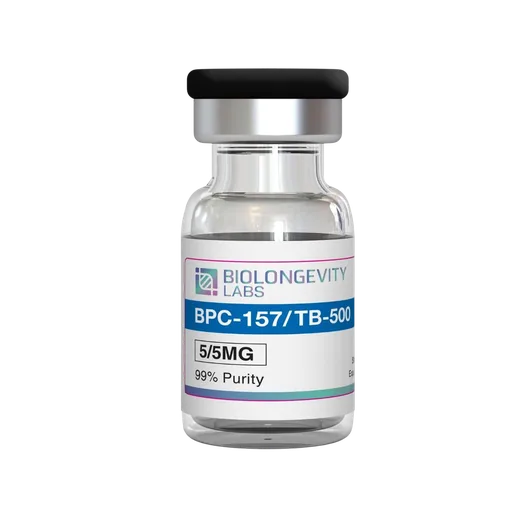
Research use only. Not for human consumption.
$68.97 as of Nov 22, 2026. Price at merchant may differ.
View research listingEducational content from an executive health coach, written as "what I would do if I were you" guidance — not medical advice, diagnosis or treatment. Injectable products sold on this site are for research use only and are not for human consumption. Talk with your licensed clinician before changing any protocol. Last reviewed November 2026.