
Cell Factors
Also known as: Cell Factors™ · Cell Factors Max · Stem-cell derived signaling factors
Cell Factors is described as an acellular placental secretome preparation, associated with regenerative signaling and tissue-repair research.
Cell Factors is described in the Handbook as a purified, acellular, DNA-free secretome derived from early placental tissues, including Wharton’s jelly, amniotic fluid and membrane, chorion, and cord blood, then lyophilized. A secretome is the mixture of signaling molecules released by cells; it can include proteins, peptides, lipids, and extracellular vesicles, so it is not a single peptide or a standardized drug class. The Handbook uses the phrase “cell-free cell therapy,” but the preparation itself is described as an acellular signaling product. Its exact composition, potency, and batch-to-batch characteristics need to be distinguished from the broader scientific literature on secretomes.
Research on cell-free secretomes and extracellular-vesicle preparations is diverse and largely preclinical, with laboratory and animal studies examining inflammation, angiogenesis, cell migration, and tissue repair. Human studies of other, differently manufactured secretome or extracellular-vesicle products do not establish results for Cell Factors or Cell Factors Max. The Handbook makes product-level claims about pathway coverage and regenerative signaling, but those claims are not equivalent to independently published clinical outcomes. There is no single study population, dose, or effect size that can be assigned to this proprietary preparation from the information available here.
The Handbook lists Cell Factors monthly, with Cell Factors Max on the first of the month for three months and then Cell Factors monthly. It categorizes the preparation as a practitioner-administered subcutaneous product and presents it in a recovery and regeneration context. This is a reported routine, not a standardized clinical protocol. Secretome preparations are highly dependent on donor material, manufacturing, purification, storage, and analytical characterization; those details determine what is actually being administered. It should not be treated as interchangeable with platelet-rich plasma, stem-cell transplantation, or another vendor’s extracellular-vesicle product.
@SupplementGraveyard review
Subscribe to @SupplementGraveyard to catch it on release.
What it is studied for
Laboratory studies of varied cell-derived secretomes and extracellular vesicles examine cell migration, inflammatory signaling, and repair-associated responses. These results are not product-specific evidence for Cell Factors.
Animal research on other secretome and extracellular-vesicle preparations has explored blood-vessel formation and tissue remodeling in injury models. Formulations and outcomes vary, so results cannot be transferred directly to this product.
The Handbook positions Cell Factors as a recovery and regeneration preparation and lists monthly use. This is a reported practice context, not a controlled clinical outcome study.
Research on diverse secretome preparations investigates cytokine and immune-cell signaling. Results depend on tissue source and manufacturing and do not establish a uniform anti-inflammatory effect.
How it works
A cell secretome can contain soluble growth factors, cytokines, chemokines, extracellular-vesicle cargo, and other signaling molecules that interact with receptors on recipient cells. In laboratory models, such signals may alter immune-cell activity, endothelial behavior, cell migration, and tissue-remodeling pathways. The Handbook describes Cell Factors as placental-derived, acellular, DNA-free, and lyophilized, but the biological activity of any preparation depends on its verified molecular composition, processing, and potency. A broad claim of pathway activation does not identify which active constituents reach a target tissue or establish a predictable clinical response.
Protocols used in studies & practitioner literature
Informational only. These are protocols reported in published studies, product labels and practitioner references, listed so you can read the research intelligently. They are not dosing instructions. Injectable products on this site are research-use-only.
- Dose
- No dose stated
- Frequency
- Monthly
- Timing
- Cell Factors Max listed on the first of the month during the initial three-month phase
- Cycle
- Cell Factors Max for three months, then Cell Factors monthly
- Route
- Subcutaneous injection (practitioner)
- Dose
- No dose stated
- Frequency
- Monthly
- Timing
- No specific day stated after transition to standard Cell Factors
- Cycle
- Monthly following three months of Cell Factors Max
- Route
- Subcutaneous injection (practitioner)
When and how it is used
- The Handbook gives a monthly interval and a three-month Cell Factors Max phase, but no dose, dilution, injection volume, or product-specific preparation method.
- Do not apply a reconstitution formula from another peptide or biologic; use only verified product-specific handling instructions under qualified clinical oversight.
- For any investigational regenerative intervention, document the product name, lot, date, route, and any local or systemic reaction with the clinician overseeing care.
- No evidence-based timeline for noticing an effect has been established for this proprietary preparation; do not use subjective changes as proof of tissue regeneration.
- Storage and post-reconstitution stability depend on the exact formulation and manufacturer; follow the verified product label and temperature requirements rather than assuming lyophilized products share the same rules.
Synergies and stacks
Considerations and cautions
- Cell Factors and Cell Factors Max are proprietary experimental biologic preparations, not FDA-approved drugs. Product-specific human efficacy, dose, pharmacokinetics, and safety data are not established.
- The Handbook’s monthly schedule does not include a quantitative dose. Do not interpret it as a validated medical protocol or extrapolate instructions from another secretome or extracellular-vesicle product.
- Acellular and DNA-free are product claims that require reliable analytical verification; they do not by themselves establish sterility, purity, potency, absence of contaminants, or clinical safety.
- Placental-derived materials and secretome products raise donor screening, manufacturing, endotoxin, immune-reaction, storage, and batch-consistency concerns. Verify the regulatory status and quality documentation with a qualified clinician and relevant authorities.
- Evidence from other cell-secretome, stem-cell, or extracellular-vesicle preparations cannot be attributed to Cell Factors without product-specific controlled studies.
The Handbook take
The Handbook describes Cell Factors as a lyophilized, acellular, DNA-free regenerative secretome sourced from early placental tissues and positions it as a signaling-based alternative to cell therapy. It lists Cell Factors Max on the first of the month for three months, followed by Cell Factors monthly. The Handbook’s routine and product description do not supply a dose or establish a clinical effect size.
Frequently asked questions
What is the reported Cell Factors schedule?
The Handbook lists Cell Factors Max monthly on the first of the month for three months, then Cell Factors monthly. It does not provide a dose or reconstitution instructions.
How long does Cell Factors take to work?
There is no validated human timeline for this proprietary preparation. Research on other secretomes cannot predict when or whether this product would produce a noticeable effect.
What side effects can Cell Factors cause?
Product-specific rates of side effects have not been established in controlled trials. Potential concerns for injectable biologics include local reactions, immune responses, contamination, and variation in biological potency.
Is Cell Factors taken orally or injected?
The Handbook describes practitioner subcutaneous use. It is not presented as an oral supplement, and the exact administration method should not be inferred from unrelated products.
Can Cell Factors be stacked with BPC-157 or TB-500?
The Handbook does not provide a validated combination protocol. Practitioner recovery stacks exist, but no controlled studies establish the safety or added benefit of these combinations.
Is Cell Factors approved or legal?
Cell Factors is a proprietary experimental biologic, not an FDA-approved medicine. Regulatory status depends on the product’s claims, composition, and jurisdiction; research-use products are not equivalent to approved therapies.
Sourcing
Related entries
Research supply
BioLongevity Labs products for laboratory research, available to buy now. BioLongevity Labs takes the order and ships it; these listings are separate from the educational material. Affiliate disclosure: BioLongevity Labs links and code JASONJOHNS (15% off eligible orders) are affiliate links and a paid code; NexGen may earn a commission at no extra cost to you if you buy through them.
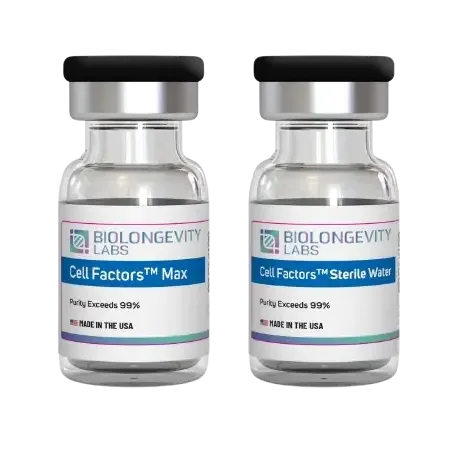
Research use only. Not for human consumption.
From $899.00 as of Nov 22, 2026. Price at merchant may differ.
View research listingEducational content from an executive health coach, written as "what I would do if I were you" guidance — not medical advice, diagnosis or treatment. Injectable products sold on this site are for research use only and are not for human consumption. Talk with your licensed clinician before changing any protocol. Last reviewed November 2026.
