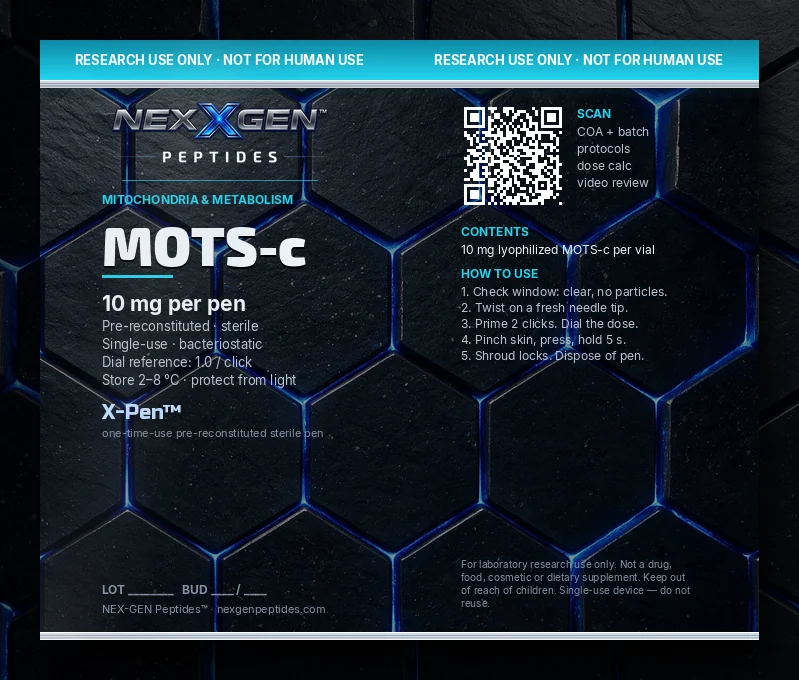
MOTS-c
Also known as: Mitochondrial open reading frame of the 12S rRNA type-c
A mitochondria-encoded signaling peptide studied for AMPK-linked metabolic regulation, exercise responses, and insulin sensitivity.
MOTS-c (mitochondrial open reading frame of the 12S rRNA type-c) is a 16-amino-acid peptide encoded within mitochondrial 12S ribosomal RNA. Lee and colleagues described it in 2015 as a mitochondria-derived signal that can influence nuclear gene expression and cellular metabolism. Unlike a conventional protein encoded in the cell nucleus, MOTS-c originates from mitochondrial DNA, giving it a role in communication between mitochondria and the rest of the cell. It is investigated as a metabolic and exercise-related signal, rather than as a replacement for exercise or a standard metabolic medicine.
Research is primarily preclinical. In cell and mouse studies, MOTS-c affected folate–methionine metabolism and increased AMPK-related signaling; treated mice showed improved glucose handling and resistance to some effects of diet-induced metabolic stress. Human research has measured endogenous MOTS-c rather than tested injected MOTS-c as a therapy. Small exercise studies report changes in circulating or muscle MOTS-c after exertion, while observational work has explored associations with age and metabolic health. These findings support biological interest but do not establish clinical effects from peptide injections in people.
In practice, MOTS-c is discussed in experimental mitochondrial and exercise-mimetic protocols, often alongside training and sometimes with SS-31 or Humanin. The Handbook groups it with those mitochondrial peptides for mitochondrial density and function, chronic fatigue, and exercise-induced malaise, and lists it as cycled by training season. Jay Campbell-style practitioner protocols describe short subcutaneous cycles, but these are not clinical treatment schedules. Exercise, sleep, nutrition, and appropriate medical evaluation remain the foundation when fatigue or metabolic concerns are present.
@SupplementGraveyard review
Subscribe to @SupplementGraveyard to catch it on release.
What it is studied for
In mouse models, MOTS-c improved glucose tolerance and reduced insulin resistance associated with high-fat feeding; these results are preclinical, not evidence of a human injection effect.
Human exercise studies have measured increases in circulating or skeletal-muscle MOTS-c after exertion. They examine the body's endogenous response, not a controlled trial of injected MOTS-c.
Observational studies have examined associations between circulating MOTS-c, age, and metabolic measures; results do not establish that supplementation changes these outcomes.
Cell experiments link MOTS-c to folate/methionine-cycle changes, AICAR accumulation, AMPK signaling, and stress-responsive gene expression.
How it works
MOTS-c has been reported to alter folate-cycle and methionine metabolism, increasing AICAR, an AMP-mimetic signal that activates AMP-activated protein kinase (AMPK). AMPK coordinates cellular energy balance, glucose uptake, fatty-acid oxidation, and mitochondrial adaptation. Under cellular stress, MOTS-c can move from the cytoplasm into the nucleus and influence stress-response gene expression, including antioxidant-response pathways. These mechanisms are demonstrated mainly in cells and animal models; the precise human pharmacology, tissue exposure after injection, and relationship between administered peptide and endogenous exercise responses remain under investigation.
Protocols used in studies & practitioner literature
Informational only. These are protocols reported in published studies, product labels and practitioner references, listed so you can read the research intelligently. They are not dosing instructions. Injectable products on this site are research-use-only.
- Dose
- 1 mg per injection
- Frequency
- Subcutaneous, 5 days on and 2 days off
- Timing
- Often coordinated with an exercise program; no validated time-of-day requirement
- Cycle
- 4–8 weeks
- Route
- Subcutaneous injection
- Dose
- 5–10 mg per injection
- Frequency
- 1–3 times weekly
- Timing
- No consistent timing convention
- Cycle
- 4–8 weeks is commonly cited
- Route
- Subcutaneous injection
- Dose
- 10 mg per week
- Frequency
- Once weekly
- Timing
- No consistent timing convention
- Cycle
- A defined short cycle is commonly used
- Route
- Subcutaneous injection
When and how it is used
- Pairing a peptide protocol with regular exercise is consistent with the Handbook's exercise-mimetic framing; MOTS-c is not a substitute for training or rehabilitation.
- Practitioner protocols commonly use a 4–8-week cycle. Track the reason for use with objective measures such as exercise tolerance, training performance, fasting glucose, and HbA1c when clinically appropriate.
- No human trial has established an optimal injection time, food relationship, storage period after reconstitution, or universal reconstitution method. Follow the dispensing pharmacy's preparation and storage directions rather than applying a generic vial calculation.
- Rotate injection sites if a licensed clinician has prescribed an injectable product; the JayCampbell reference notes that larger dilution volumes may reduce local reactivity, but product concentration and diluent must be confirmed with the dispensing source.
- A change in energy or exercise tolerance, if it occurs, should be assessed over the planned cycle rather than assumed after a single dose.
Synergies and stacks
Considerations and cautions
- MOTS-c injections are sold as research-use-only products on this site; no approved human therapeutic indication or established clinical injection dose is available. Human therapeutic safety, interactions, and long-term effects have not been characterized.
- Potential injection-site pain, redness, or swelling is reported in practitioner use; larger dilution volumes are sometimes used to reduce local irritation, but sterile preparation and product-specific instructions are essential.
- Do not use a research peptide in place of assessment for persistent fatigue, exercise intolerance, diabetes, or other medical conditions. People using glucose-lowering medicines should discuss experimental metabolic agents with a clinician because of possible effects on glucose regulation.
- Product identity, purity, concentration, and sterility vary among research suppliers. MOTS-c is prohibited by the World Anti-Doping Agency under the category of metabolic modulators.
The Handbook take
The Handbook groups MOTS-c with Humanin and SS-31 as mitochondrial peptides intended to support mitochondrial density and function, particularly in its discussion of chronic fatigue and exercise-induced malaise. It lists mitochondrial peptides as cycled by training season and describes SS-31 as a mitochondrial-repair step before MOTS-c. These are the Handbook's framework and protocol concepts, not a clinical guideline.
Frequently asked questions
What dose of MOTS-c is commonly reported?
Practitioner protocols commonly cite 1 mg subcutaneously five days per week, with two days off, for 4–8 weeks. Other practitioner schedules cite 5–10 mg one to three times weekly or 10 mg weekly; none is a validated human treatment dose.
How long does MOTS-c take to work?
There is no reliable human timeline for effects from injected MOTS-c. Exercise-related changes in endogenous MOTS-c have been observed around exertion, but that does not predict the response to a peptide injection.
What side effects can MOTS-c cause?
Injection-site irritation, redness, and discomfort are reported in practitioner use. Human safety data are limited, so systemic effects and longer-term risks are not well characterized.
Is MOTS-c taken orally or by injection?
The protocols cited by practitioners use subcutaneous injection. Oral MOTS-c has no established human clinical protocol, and research-use injectable products require careful attention to sterility and handling.
Can MOTS-c be stacked with SS-31 or Humanin?
The Handbook places MOTS-c alongside SS-31 and Humanin in its mitochondrial-peptide framework. Controlled studies have not established the safety or added benefit of combining them.
Is MOTS-c legal or allowed in sport?
Its legal status depends on jurisdiction and intended sale or use; products sold on this site are research-use-only. MOTS-c is prohibited in sport under the World Anti-Doping Agency's metabolic-modulator category.
Sourcing
Related entries
Research supply
BioLongevity Labs products for laboratory research, available to buy now. BioLongevity Labs takes the order and ships it; these listings are separate from the educational material. Affiliate disclosure: BioLongevity Labs links and code JASONJOHNS (15% off eligible orders) are affiliate links and a paid code; NexGen may earn a commission at no extra cost to you if you buy through them.
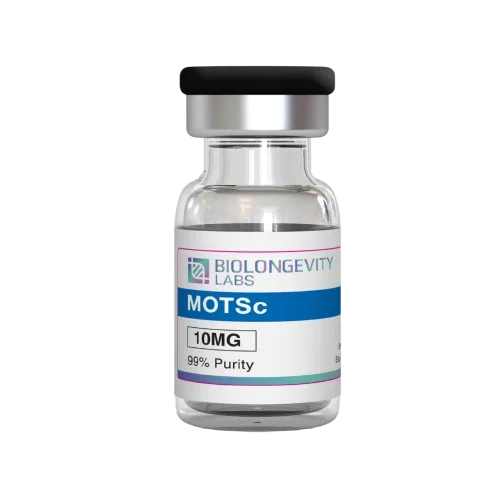
Research use only. Not for human consumption.
$51.97 as of Nov 22, 2026. Price at merchant may differ.
View research listingEducational content from an executive health coach, written as "what I would do if I were you" guidance — not medical advice, diagnosis or treatment. Injectable products sold on this site are for research use only and are not for human consumption. Talk with your licensed clinician before changing any protocol. Last reviewed November 2026.