
Reviews Peptides Metabolic & Mitochondrial Research
MOTS-c (10 mg)
Also known as MOTSc, Mitochondrial ORF of the 12S rRNA type-c
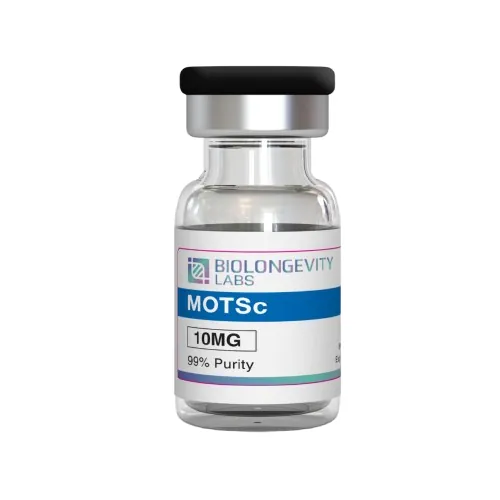
MOTS-c, a 16-residue peptide encoded in mitochondrial DNA, in a 10 mg vial. Mouse studies show metabolic and endurance effects; no completed human efficacy trials exist.
- Advanced (draft)
- Compound evidence C · Animal / preclinical
- In the Handbook of Health
- lyophilized vial
- Rank pending
Grades describe published research on the compound, not this product.
What it is
MOTS-c is a mitochondrial-derived peptide first described in 2015. It is encoded within the mitochondrial 12S rRNA gene, signals through AMPK, and can move to the nucleus under stress to regulate genes. BLL supplies the free-acid linear sequence MRWQEMGYIFYPRKLR, 10 mg per vial.
What it has been studied for
Insulin sensitivity and diet-induced obesity in mice
AnimalThe 2015 discovery paper showed MOTS-c activates AMPK via the folate cycle and prevented diet-induced obesity and insulin resistance in mice.
Physical capacity across ages in mice
AnimalMOTS-c improved running performance in young, middle-aged and old mice; exercise raised endogenous MOTS-c in human muscle and blood.
Human evidence
Traditional useJay Campbell notes there are no completed human fat-loss trials; the only clinical data are a phase 1/1b study of an analogue (CB4211) plus anecdotes.
This study examined the research compound, not the product sold by BioLongevity Labs. The findings do not establish that the product is safe or effective for people.
Research contexts
- Mitochondrial-nuclear signalling research
- Exercise-mimetic and metabolic-flexibility literature reviews
Cautions & unknowns
- No completed human efficacy trials; long-term safety unknown.
- Injection-site reactions are the most commonly reported anecdotal effect.
- Unapproved peptides fall under WADA's S0 (non-approved substances) category; not for tested athletes.
- Not studied in pregnancy or nursing.
- Research peptide vials are not sterile drug products; nothing here covers administration, reconstitution or dosing.
- BioLongevity Labs designates this vial for in vitro research use only; the merchant states it is not for human or veterinary administration. This review describes the compound and published research only, with no dosing, reconstitution or personal-use guidance.
- No statement here has been evaluated by the FDA; nothing in this review is medical advice.
Jason’s take
Jason's hands-on review is coming.
Handbook §27 lists MOTS-c among mitochondrial peptides used by training season; §22 ('MOTs-C w/ Humanin') and §21 (mitochondrial dysfunction) also mention it. Brand not named.
Handbook §27 “My Current Protocol (Bonus Exclusive Content)”: Mitochondrial peptides rotated by training season.
Handbook §22 “Everything Mitochondria”: 'MOTs-C Peptide w/ Humanin'.
Handbook §21 “12 Hallmarks of Aging (w/ Solutions)”: Intervention under mitochondrial dysfunction.
Compared products
One product reviewed so far. Comparison slots stay empty until Jason chooses alternatives.
- Product 1
BioLongevity Labs
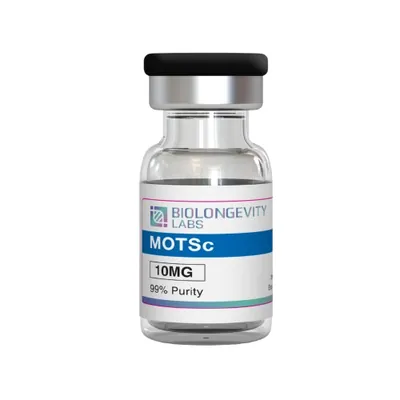
MOTS-c (10mg)
SKU MOT10 · 10 mg
In the Handbook of Health
Where it shines
- 10 mg per vial at $51.97 (about $5.20 per mg, list price 2026-11-22).
- Sequence, termini (free acid, linear) and CAS disclosed; no carrier blend.
- BLL states every batch is tested by an independent third-party lab (AV Analytics or BioRegen) against a ≥99% HPLC purity specification, with certificates published online and verifiable via QR/report codes.
Where it falls short
- Mouse effects used doses and schedules that have not been translated to people.
- Certificates are published online, not shipped with the vial, and no lot certificate was independently audited for this review.
Verdict: An exciting, well-cited mitochondrial peptide that remains a mouse-stage compound.
$51.97 as of Nov 22, 2026 at BioLongevity Labs
For in vitro research use only. Not for human or animal use.
NexGen formulation
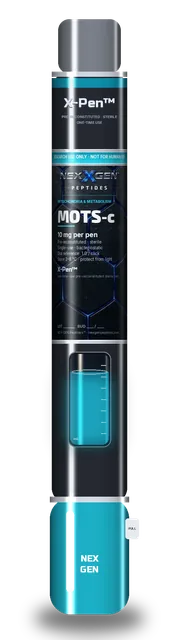
NexGen formulation in development
NexGen™ is Jason Johns' own brand. Illustrative render: formulation and name are not final.
Related reviews
- NAD+ / MOTS-c / 5-Amino-1MQ Blend (120 mg)Peptides · Compound evidence C
- NAD+ (500 mg)Peptides · Compound evidence C
- 5-Amino-1MQ (10mg)Peptides · Compound evidence C
- ShredMAX (SLU-PP-332, 100 mg capsule)Peptide Supplements · Compound evidence C
- BioAmp (ATX-304 / O304, 100 mg)Peptide Supplements · Compound evidence B
- BioRecharge (urolithin A + pomegranate + C60 + alpha-lipoic acid)Peptide Supplements · Compound evidence B
Sources
- MOTS-c (10mg) product page BioLongevity Labs · accessed Nov 22, 2026
- MOTS-C Side Effects Jay Campbell · accessed Nov 22, 2026
- MOTS-C vs Semaglutide Jay Campbell · accessed Nov 22, 2026
- The mitochondrial-derived peptide MOTS-c promotes metabolic homeostasis and reduces obesity and insulin resistance (2015) PubMed · accessed Nov 22, 2026
- MOTS-c is an exercise-induced mitochondrial-encoded regulator of age-dependent physical decline (2021) PubMed · accessed Nov 22, 2026
Updated Nov 22, 2026. Written by the NexGen research team for @SupplementGraveyard™. Jason Johns is an executive health coach, not a licensed healthcare provider. This content is educational only and does not create a provider-patient relationship.