
Klotho
Also known as: α-Klotho · Klotho-MAB · αKlotho-LR
Klotho is a kidney-associated protein and FGF23 co-receptor studied for phosphate regulation, vascular and kidney aging, and cognition.
α-Klotho is a membrane protein expressed mainly in the kidney, with soluble forms produced by cleavage and alternative processing. It was identified through a mouse mutation that caused a premature-aging-like phenotype, leading to its study as a longevity-associated protein. Membrane Klotho acts as a co-receptor for fibroblast growth factor 23 (FGF23), while circulating Klotho has additional proposed signaling roles. “Klotho-MAB” and “αKlotho-LR” are product or construct names in the Handbook’s materials, not interchangeable names for the body’s endogenous protein. The Handbook describes its αKlotho-LR construct as a recombinant, albumin-binding long-release protein.
Animal studies established much of the foundational biology: Klotho-deficient mice develop abnormalities involving phosphate balance, kidney function, and premature aging, while Klotho overexpression in mice was reported to extend lifespan and improve several age-associated measures. In people, observational studies have linked circulating Klotho levels with measures of kidney function, vascular health, and cognition, but association does not show that administering Klotho produces those outcomes. Evidence about endogenous Klotho also cannot establish the effectiveness of a proprietary long-release construct. No controlled human outcome study of the Handbook’s named construct is described in the materials provided here.
The Handbook presents Klotho-MAB/αKlotho-LR as a long-release recombinant “longevity protein,” describes an albumin-binding tail and activity lasting up to about 19 days, and places it in a longevity-oriented routine every 12 days. That schedule is a reported Handbook routine, not a clinical dosing standard. It is best understood as an advanced experimental biologic rather than a conventional supplement; the animal genetics and human observational literature provide biological context but do not validate a commercial injection schedule. Kidney function, phosphate, calcium, vitamin D, and FGF23 biology are clinically relevant considerations for any intervention affecting this pathway.
@SupplementGraveyard review
Subscribe to @SupplementGraveyard to catch it on release.
What it is studied for
Klotho-deficient mice show premature-aging-like features, while a landmark mouse overexpression study reported lifespan extension. Genetic manipulation in mice does not establish that protein administration extends human lifespan.
Klotho-deficient animal models show disrupted FGF23 signaling, phosphate handling, and kidney-related physiology, supporting its role as an FGF23 co-receptor.
Human observational studies have examined circulating Klotho alongside cognitive and vascular measures. These associations do not demonstrate a benefit from Klotho injections.
Circulating Klotho has been studied in relation to kidney function and chronic kidney disease markers; renal status itself can affect Klotho levels, complicating causal interpretation.
How it works
Membrane α-Klotho forms a functional co-receptor complex with FGF receptors, enabling FGF23 signaling that promotes renal phosphate excretion and suppresses active vitamin D synthesis. This links Klotho to phosphate, calcium, and vitamin D homeostasis. Soluble Klotho can act beyond the membrane and has been investigated in pathways involving oxidative stress responses, Wnt signaling, and vascular function. The Handbook’s albumin-binding long-release construct is described as a way to extend exposure, but the mechanism and pharmacokinetics of that specific product should not be assumed to match endogenous Klotho or other experimental constructs.
Protocols used in studies & practitioner literature
Informational only. These are protocols reported in published studies, product labels and practitioner references, listed so you can read the research intelligently. They are not dosing instructions. Injectable products on this site are research-use-only.
- Dose
- No dose stated in the Handbook routine
- Frequency
- Every 12 days
- Timing
- No time of day specified
- Cycle
- Repeated every 12 days in the listed routine
- Route
- Subcutaneous injection (practitioner)
- Dose
- No dose stated
- Frequency
- Described as long-release, with activity claimed for up to about 19 days
- Timing
- Not given
- Cycle
- Not given
- Route
- Recombinant protein; the item is categorized as practitioner subcutaneous use
When and how it is used
- The Handbook’s listed interval is every 12 days; it does not provide a dose, reconstitution volume, or preparation instructions.
- Do not infer an injection amount or vial dilution from the reported interval. Follow only product-specific clinician and manufacturer handling directions where applicable.
- Because the pathway affects mineral balance, a clinician may consider kidney function, serum phosphate, calcium, 25-hydroxyvitamin D, and relevant medications when assessing exposure.
- The claimed long-release interval of up to about 19 days is a product description, not a clinically established pharmacokinetic result for all Klotho products.
- No reliable human timeline for perceived cognitive, vascular, or longevity effects is available.
Synergies and stacks
Considerations and cautions
- Klotho-MAB/αKlotho-LR products are experimental biologics; they are not FDA-approved medicines, and human dose, safety, pharmacokinetic, and efficacy data for the named construct are not established.
- The every-12-day schedule is a Handbook-reported routine, not a medically validated dose regimen. Do not extrapolate dosing from animal models or the claimed duration of activity.
- Changing FGF23–Klotho signaling may alter phosphate, calcium, vitamin D, and kidney physiology. Kidney disease or abnormal mineral metabolism calls for specialist review; interactions with mineral-active medicines are a concern.
- Injectable research biologics carry risks from sterility failures, endotoxin, mislabeling, aggregation, and uncertain potency. Claims about proprietary sourcing or testing require independent verification.
The Handbook take
The Handbook describes Klotho-MAB/αKlotho-LR as a recombinant, albumin-binding “longevity protein,” with a claimed activity duration of up to about 19 days. It lists αKlotho-LR every 12 days in its personal routine and frames it around cognition, vascular health, and kidney aging. These are the Handbook’s product claims and routine context; they are distinct from the established biology of endogenous Klotho.
Frequently asked questions
What is the reported Klotho protocol?
The Handbook lists αKlotho-LR every 12 days, but gives no dose or reconstitution instructions. The interval is a reported routine, not a clinical dosing standard.
How long before Klotho produces results?
There is no human timeline for benefits from the named construct. Animal and observational findings cannot predict a personal response to an experimental protein.
What side effects can Klotho injections cause?
The human side-effect profile of the named product has not been characterized in controlled trials. Because Klotho participates in FGF23 and mineral regulation, phosphate, calcium, vitamin D, and kidney effects are important clinical concerns.
Is Klotho taken orally or by injection?
The Handbook describes αKlotho-LR/Klotho-MAB as a recombinant protein used by subcutaneous injection in practitioner settings. Oral use is not the route described for this construct.
Can Klotho be stacked with other longevity compounds?
The Handbook lists it alongside other longevity and mitochondrial interventions, but clinical trials have not established a safe or effective stack. A clinician should review the whole medication and supplement list, especially with kidney or mineral-balance issues.
Is Klotho legal or approved for use?
The named Klotho biologic is not an FDA-approved medicine, and regulatory status can depend on product and jurisdiction. Products sold for research use are not the same as an approved, quality-controlled therapy.
Sourcing
Related entries
Research supply
BioLongevity Labs products for laboratory research, available to buy now. BioLongevity Labs takes the order and ships it; these listings are separate from the educational material. Affiliate disclosure: BioLongevity Labs links and code JASONJOHNS (15% off eligible orders) are affiliate links and a paid code; NexGen may earn a commission at no extra cost to you if you buy through them.
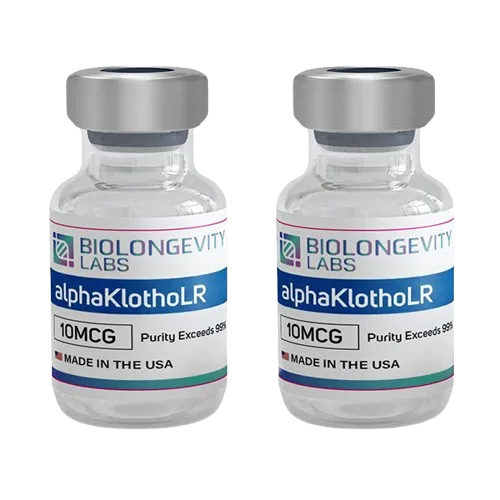
Research use only. Not for human consumption.
From $299.00 as of Nov 22, 2026. Price at merchant may differ.
View research listingEducational content from an executive health coach, written as "what I would do if I were you" guidance — not medical advice, diagnosis or treatment. Injectable products sold on this site are for research use only and are not for human consumption. Talk with your licensed clinician before changing any protocol. Last reviewed November 2026.
