
Follistatin (FLGR-242)
Also known as: Follistatin 344 · FLGR-242 Follistatin
Follistatin is an activin- and myostatin-binding protein studied for muscle growth, muscular disorders, and muscle-preservation biology.
Follistatin is a naturally occurring glycoprotein that binds members of the TGF-β superfamily, including activins and myostatin. Follistatin-344 is a precursor form that can be processed into circulating and tissue-associated forms. By binding myostatin, follistatin can reduce signaling that limits skeletal-muscle growth; its effects are not limited to muscle because activins regulate reproductive, endocrine, vascular, and other functions. FLGR-242 is described in the Handbook as a proprietary, albumin-bound follistatin-344 fragment designed for prolonged activity. That product description should be distinguished from published studies of endogenous follistatin or gene transfer.
In animals, increased follistatin signaling can produce marked increases in muscle mass, which prompted investigation for muscle-wasting disorders. Human research includes a small gene-transfer study in six people with Becker muscular dystrophy: participants received intramuscular AAV1-follistatin gene transfer and were followed for about two years, with reports of improved walking measures in the study cohort. This was an early, small clinical study of gene transfer—not a trial of injected FLGR-242 protein, bodybuilding use, or the Handbook’s proposed microdosing schedule. The distinction matters: delivery method, tissue exposure, and duration can change both effects and risks.
The Handbook frames FLGR-242 as an albumin-bound follistatin construct that binds myostatin and activin, and lists daily microdosing before hard training. It associates the pathway with muscle growth, repair, and body-composition research. In current practice, this is an experimental biologic concept, not a standard sports-medicine intervention. Resistance training provides a meaningful muscle-building stimulus without manipulating broad growth-factor pathways; any clinical investigation involving follistatin requires specialist oversight, clear product identity, and a defined monitoring plan. No dose is provided in the Handbook, so its “microdose” language does not translate into a reproducible amount.
@SupplementGraveyard review
Subscribe to @SupplementGraveyard to catch it on release.
What it is studied for
Animal models with increased follistatin activity show substantial skeletal-muscle growth and reduced myostatin signaling. The degree of effect in those models does not predict response to a human protein product.
An early study delivered AAV1-follistatin gene therapy to six people with Becker muscular dystrophy and followed them for roughly two years; investigators reported improvement in walking measures in the small cohort. This was gene transfer, not FLGR-242 injection.
Cell and tissue studies examine follistatin’s binding of myostatin and activins and downstream effects on muscle growth and repair signaling.
Animal research has explored muscle and adipose-tissue changes when myostatin/activin signaling is altered. Findings do not establish a fat-loss or muscle-gain effect for FLGR-242 in people.
How it works
Follistatin binds and sequesters activin A/B and myostatin (GDF-8), reducing their access to activin type II receptors and downstream SMAD2/3 signaling. Since myostatin normally restrains muscle growth, lowering that signal can increase muscle-fiber size and alter satellite-cell activity in experimental models. Activin binding broadens the biological footprint beyond muscle, with potential effects on reproductive hormones, pituitary signaling, vascular biology, and tissue remodeling. Albumin binding, as described for FLGR-242, is intended to prolong circulating exposure; the pharmacology of that proprietary construct cannot be inferred from other follistatin forms or gene-transfer studies.
Protocols used in studies & practitioner literature
Informational only. These are protocols reported in published studies, product labels and practitioner references, listed so you can read the research intelligently. They are not dosing instructions. Injectable products on this site are research-use-only.
- Dose
- “Microdose”; no quantitative amount stated
- Frequency
- Daily
- Timing
- Before hard training
- Cycle
- No cycle length stated
- Route
- Subcutaneous injection (practitioner)
- Dose
- Study-specific AAV1-follistatin gene-transfer dose
- Frequency
- Single gene-transfer treatment in the study protocol
- Timing
- Administered under clinical-trial supervision
- Cycle
- Follow-up of approximately two years
- Route
- Intramuscular AAV1 gene transfer
When and how it is used
- The Handbook gives a training-relative schedule—before hard workouts—but does not give a measurable dose or preparation method.
- Do not translate the Becker muscular dystrophy gene-transfer study into a protein dose; AAV gene transfer and an injected follistatin construct are different interventions.
- Track strength, training volume, muscle circumference, and recovery only as clinical or research outcomes; changes in muscle mass alone do not establish safe tissue-specific action.
- No validated timeline for FLGR-242 effects is available. The Handbook’s daily routine is a reported personal protocol, not a trial-derived schedule.
- Do not reconstitute or inject an investigational biologic without qualified clinical oversight and verified product-specific sterile handling instructions.
Synergies and stacks
Considerations and cautions
- FLGR-242 is described as a research-use-only injectable biologic and is not an FDA-approved drug. Human dose, safety, pharmacokinetics, and efficacy data for this proprietary construct are not established.
- The Handbook says “daily microdose before hard training” without a quantitative dose. Do not treat that wording as an actionable, validated dosing regimen.
- Follistatin affects myostatin and activin pathways beyond skeletal muscle; potential endocrine, reproductive, vascular, and tissue-remodeling effects require particular caution. The long-term consequences of chronic pathway suppression are unknown.
- The Becker muscular dystrophy study used AAV gene transfer, not injected FLGR-242. Its results cannot establish the safety or effectiveness of a different product or route.
- Unregulated injectable biologics may have uncertain identity, potency, sterility, endotoxin burden, or albumin-binding characteristics. Athletes should also check current sport rules before using experimental growth-pathway agents.
The Handbook take
The Handbook presents FLGR-242 as an albumin-bound follistatin-344 fragment and describes it as releasing the myostatin and activin “brake” on muscle growth. It lists daily microdosing before hard training and links the compound to muscle, metabolism, and repair. The Handbook does not give a quantitative dose; the listed timing is its reported routine rather than a human trial protocol.
Frequently asked questions
What dose of FLGR-242 is reported?
The Handbook says “daily microdose” before hard training but gives no numerical dose. The phrase does not define a reproducible or clinically tested amount.
How long does follistatin take to build muscle?
There is no reliable timeline for FLGR-242 in humans. The small human research study used gene transfer for Becker muscular dystrophy, not this construct or a bodybuilding protocol.
What side effects are possible with follistatin?
The side effects of FLGR-242 have not been characterized in controlled human trials. Because follistatin binds activins as well as myostatin, effects may extend to endocrine, reproductive, vascular, and tissue-remodeling pathways.
Is FLGR-242 oral or injectable?
The Handbook describes it as an injectable biologic, and the item is categorized for practitioner subcutaneous use. The Becker muscular dystrophy study used intramuscular gene transfer, which is a different intervention.
Can follistatin be stacked with training or other peptides?
The Handbook pairs its reported routine with hard training, but a safe additive benefit has not been demonstrated. There are no established clinical stacking studies with other peptides or growth-pathway compounds.
Is FLGR-242 legal or approved for sport?
FLGR-242 is not an FDA-approved medicine, and its legal status depends on jurisdiction and product claims. Athletes should check current rules with their governing body before exposure to experimental growth-pathway agents.
Sourcing
Related entries
Research supply
BioLongevity Labs products for laboratory research, available to buy now. BioLongevity Labs takes the order and ships it; these listings are separate from the educational material. Affiliate disclosure: BioLongevity Labs links and code JASONJOHNS (15% off eligible orders) are affiliate links and a paid code; NexGen may earn a commission at no extra cost to you if you buy through them.
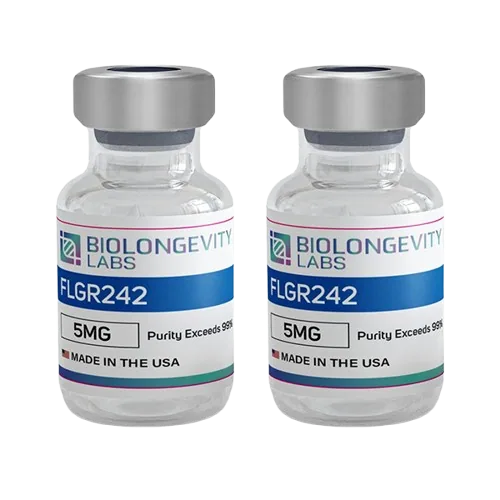
Research use only. Not for human consumption.
From $299.00 as of Nov 22, 2026. Price at merchant may differ.
View research listingEducational content from an executive health coach, written as "what I would do if I were you" guidance — not medical advice, diagnosis or treatment. Injectable products sold on this site are for research use only and are not for human consumption. Talk with your licensed clinician before changing any protocol. Last reviewed November 2026.
