
Oxytocin
Also known as: Pitocin (Rx) · Intranasal oxytocin
A nine-amino-acid hormone studied for social cognition, stress responses and sexual function; prescription oxytocin also has obstetric uses.
Oxytocin is a nine-amino-acid peptide hormone made mainly in hypothalamic neurons and released into the bloodstream from the posterior pituitary; it is also released within the brain. The synthetic medicine Pitocin contains oxytocin and is used in obstetrics. Intranasal oxytocin has been studied as a way to influence central signaling, although the amount reaching the brain varies and nasal delivery is not equivalent to an obstetric injection or infusion. Research interest spans social attention, trust, emotional processing, stress physiology and sexual response. Its effects depend on context, dose, individual characteristics and the social setting rather than acting as a simple universal “bonding” signal.
Human studies commonly use a single intranasal dose, often 24 IU, before a laboratory task. Trials have measured recognition of emotional expressions, gaze to social cues, trust-game decisions, cortisol responses and partner interaction; results vary across tasks and populations. In a randomized placebo-controlled study of 24 men, 24 IU increased gaze to the eye region during social viewing, while subsequent research has found mixed effects on trust and emotion recognition. Small studies in couples and men with sexual difficulties have examined intimacy, orgasm or sexual response, but they do not establish a consistent effect across users. These outcomes are behavioral or physiological research endpoints, not evidence that oxytocin reliably creates attachment or improves relationships.
In clinical practice, synthetic oxytocin is administered by medical staff for labor induction or augmentation and for postpartum uterine contraction, using carefully monitored IV or IM protocols. Intranasal products are research tools in many behavioral studies, with dose and timing selected for the experiment; they are not interchangeable with Pitocin. The Handbook mentions oxytocin briefly in its hormone and sexual-health context and peptide guide, without laying out a personal dosing routine. It therefore fits here as a topic for clinician-led discussion or research-literacy education, not as a casual add-on to a supplement stack.
@SupplementGraveyard review
Subscribe to @SupplementGraveyard to catch it on release.
What it is studied for
Small randomized experiments using a single 24 IU intranasal dose have reported altered gaze toward eyes and changes in recognition of social cues; later studies show variable results by task and participant.
Laboratory trials have measured cortisol and autonomic responses during social stress after intranasal dosing, with effects varying by sex, social support and experimental context.
Small clinical studies and case reports have examined orgasm, sexual response and partner interaction; the literature is preliminary and does not show a reliable effect for all users.
Prescription oxytocin is used in monitored obstetric settings to induce or augment labor and promote uterine contraction after delivery.
How it works
Oxytocin binds the oxytocin receptor, a G-protein-coupled receptor that signals chiefly through Gq/11, phospholipase C, IP3 and intracellular calcium. In uterine smooth muscle this raises contractility; in lactation it supports milk ejection. In the brain, receptor signaling in regions including the amygdala, hypothalamus, nucleus accumbens and brainstem can alter salience assigned to social cues, threat processing and autonomic responses. Receptor distribution and signaling are shaped by sex hormones, developmental history and context. Oxytocin also interacts functionally with vasopressin systems, which helps explain why behavioral effects are task- and person-dependent rather than uniformly pro-social.
Protocols used in studies & practitioner literature
Informational only. These are protocols reported in published studies, product labels and practitioner references, listed so you can read the research intelligently. They are not dosing instructions. Injectable products on this site are research-use-only.
- Dose
- 24 IU
- Frequency
- Single dose
- Timing
- Typically 30–45 minutes before the task
- Cycle
- One experimental session
- Route
- Intranasal
- Dose
- Initial IV infusion 0.5–1 mU/min; titrate by 1–2 mU/min at 30–60-minute intervals according to uterine response and fetal monitoring
- Frequency
- Continuous IV infusion under obstetric supervision
- Timing
- During labor when clinically indicated
- Cycle
- Until an adequate contraction pattern is achieved or the infusion is stopped by the clinical team
- Route
- Intravenous infusion
When and how it is used
- Intranasal research studies generally administer the dose before the behavioral task and allow roughly 30–45 minutes for absorption.
- Do not convert IU doses between nasal sprays, compounded products and injectable Pitocin; delivery devices and concentrations differ.
- For obstetric use, uterine activity and fetal heart rate are monitored continuously or at the frequency specified by the care team.
- Track the specific outcome being evaluated—such as validated sexual-function measures, stress response or task performance—rather than relying on a subjective impression of bonding.
- Intranasal study effects are assessed on the same day; there is no established supplement-style loading or cycling routine.
Synergies and stacks
Considerations and cautions
- Pitocin is a prescription medicine in the United States; labor-related oxytocin requires a licensed prescriber and trained obstetric staff. It can cause uterine tachysystole, fetal distress, water intoxication/hyponatremia, hypotension and, rarely, uterine rupture; it is not for unsupervised use.
- Intranasal oxytocin is not an FDA-approved treatment for social, stress or sexual concerns. Research formulations and consumer products can differ in concentration, sterility and delivery.
- Potential effects include nasal irritation, headache, nausea and changes in blood pressure or heart rate. Use requires particular caution in pregnancy, cardiovascular disease, seizure disorders and with medicines that affect fluid balance or uterine activity.
- Oxytocin is prohibited in sport under some circumstances by anti-doping rules; athletes should check the current WADA list and obtain therapeutic-use guidance where applicable.
The Handbook take
The Handbook lists oxytocin briefly in its peptide guide and hormone/sexual-health context. It does not provide a specific dose, timing plan or defined combination routine.
Frequently asked questions
What dose of intranasal oxytocin is used in studies?
A common single research dose is 24 IU, with studies also using doses across roughly 12–40 IU. Protocols specify the product and timing, often about 30–45 minutes before a task; this is not a personal-use prescription.
How quickly does intranasal oxytocin work?
Behavioral studies usually assess outcomes within about 30–60 minutes after dosing. Effects depend on the task and person, and there is no predictable subjective sensation that confirms a response.
What are oxytocin’s side effects?
Intranasal use can cause nasal irritation, headache or nausea. Prescription oxytocin can cause excessive uterine contractions, fetal distress, hypotension and fluid/electrolyte complications, which is why obstetric administration is monitored.
Is oxytocin taken orally, under the tongue or by injection?
Behavioral research generally uses intranasal administration, while Pitocin is given by IV infusion or IM injection for medical obstetric indications. Oral or sublingual products are not equivalent to these formulations.
Can oxytocin be stacked with other peptides?
There is no validated general-purpose peptide stack for oxytocin. Combinations should be reviewed by a prescriber, particularly in pregnancy or when other medicines affect blood pressure, fluid balance or uterine activity.
Is oxytocin legal and does it affect drug testing?
Pitocin is prescription-only in the United States, and intranasal research products are not approved for routine social or sexual use. Sport rules may prohibit oxytocin in certain circumstances, so athletes should check current anti-doping guidance.
Sourcing
Related entries
Research supply
BioLongevity Labs products for laboratory research, available to buy now. BioLongevity Labs takes the order and ships it; these listings are separate from the educational material. Affiliate disclosure: BioLongevity Labs links and code JASONJOHNS (15% off eligible orders) are affiliate links and a paid code; NexGen may earn a commission at no extra cost to you if you buy through them.
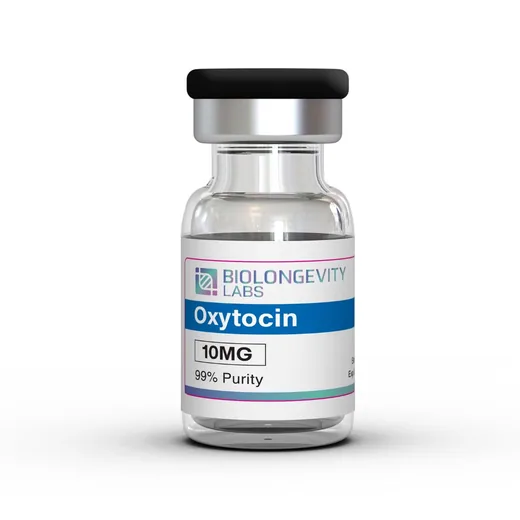
Research use only. Not for human consumption.
$63.97 as of Nov 22, 2026. Price at merchant may differ.
View research listingEducational content from an executive health coach, written as "what I would do if I were you" guidance — not medical advice, diagnosis or treatment. Injectable products sold on this site are for research use only and are not for human consumption. Talk with your licensed clinician before changing any protocol. Last reviewed November 2026.
