
PT-141
Also known as: Bremelanotide · Vyleesi
PT-141 (bremelanotide) is a melanocortin-receptor agonist studied for sexual desire and arousal; its Vyleesi formulation is prescribed for HSDD in premenopausal women.
PT-141, also called bremelanotide, is a synthetic cyclic peptide derived from the melanocortin peptide family and related to α-melanocyte-stimulating hormone. Unlike medicines that act mainly on peripheral genital blood vessels, bremelanotide acts centrally through melanocortin receptors involved in sexual motivation and arousal. The prescription product Vyleesi is a prefilled subcutaneous autoinjector. The FDA indication is narrow: acquired, generalized hypoactive sexual desire disorder (HSDD) in premenopausal women when the condition causes marked distress or interpersonal difficulty and is not due to a coexisting medical or psychiatric condition, relationship problems, or medication effects.
The strongest clinical evidence comes from two 24-week phase 3 RECONNECT trials involving 1,247 premenopausal women with HSDD. Bremelanotide produced statistically significant improvements in desire and distress scores versus placebo, although the average between-group changes were modest: desire-score improvement was about 0.5 versus 0.2 points, and the increase in satisfying sexual events was about 0.7 versus 0.4. The FDA label notes nausea as the most common adverse reaction. Earlier studies in men explored erectile response through central melanocortin signaling, but Vyleesi is not labeled for male erectile dysfunction. A person’s response and tolerability can differ from trial averages.
In current practice, the labeled Vyleesi regimen is an as-needed 1.75-mg subcutaneous dose at least 45 minutes before anticipated sexual activity, with no more than one dose in 24 hours and eight doses per month. The label recommends stopping after eight weeks if there is no improvement. Jay Campbell describes lower 0.5–1-mg test doses and a 1–2-mg practitioner range 45 minutes to four hours before activity; these are not the same as the approved product instructions. The Handbook places PT-141 in its sexual-function discussion alongside Melanotan 2. It distinguishes PT-141 from tanning-oriented melanocortin peptides, though its dopamine-pathway description is a simplified account of a more complex central mechanism.
@SupplementGraveyard review
Subscribe to @SupplementGraveyard to catch it on release.
What it is studied for
Two 24-week phase 3 RECONNECT trials enrolled 1,247 women. Desire and distress measures improved versus placebo; mean gains were modest, and satisfying sexual events increased by roughly 0.7 versus 0.4.
Early clinical studies examined melanocortin agonists for erectile response, including men who did not respond adequately to conventional approaches; these data do not establish a male indication for the Vyleesi product.
Practitioner protocols describe use before anticipated sexual activity for central libido or arousal effects; this use extends beyond the FDA-labeled population and requires individualized clinical assessment.
Receptor and signaling research supports a central melanocortin pathway distinct from the peripheral nitric-oxide/cGMP mechanism targeted by PDE5 inhibitors.
How it works
Bremelanotide activates melanocortin receptors, especially MC4R and also MC1R, in central neural circuits that regulate sexual motivation and arousal. MC4R is a Gs-coupled receptor; activation increases adenylyl cyclase/cAMP signaling in relevant neurons and influences downstream hypothalamic and limbic pathways. The mechanism is distinct from phosphodiesterase-5 inhibitors such as sildenafil, which enhance nitric-oxide/cGMP signaling in penile smooth muscle. Bremelanotide is not a direct dopamine agonist; central melanocortin signaling can interact with neural systems governing sexual response. Its effects can occur without a direct peripheral vasodilatory action, and the precise human pathway for desire changes is not fully mapped.
Protocols used in studies & practitioner literature
Informational only. These are protocols reported in published studies, product labels and practitioner references, listed so you can read the research intelligently. They are not dosing instructions. Injectable products on this site are research-use-only.
- Dose
- 1.75 mg
- Frequency
- As needed; no more than one dose in 24 hours and no more than eight doses per month
- Timing
- At least 45 minutes before anticipated sexual activity
- Cycle
- Discontinue after 8 weeks if no improvement in symptoms
- Route
- Subcutaneous injection using the Vyleesi autoinjector
- Dose
- 1–2 mg; Jay Campbell describes starting at 0.5–1 mg to assess tolerability
- Frequency
- As needed before anticipated activity
- Timing
- 45 minutes to 4 hours before activity
- Cycle
- No more than one dose in 24 hours; the FDA label also limits use to eight doses per month
- Route
- Subcutaneous injection
When and how it is used
- For the prescription autoinjector, use the labeled dose and device instructions; do not transfer a dose or mixing method from a research peptide vial to Vyleesi.
- The labeled timing is at least 45 minutes before anticipated sexual activity. The effect is not a guarantee of sexual response and does not require taking the drug with food.
- Track response, nausea, flushing, headache, injection-site reaction, blood pressure, and the number of monthly doses. The label advises stopping after eight weeks without improvement.
- The Vyleesi autoinjector is a single-dose product; store and handle it according to the package insert. Do not use a damaged or improperly stored device.
- If taking an oral medicine that requires a rapid or reliable absorption, discuss timing with a pharmacist: bremelanotide can slow gastric emptying and may affect absorption of oral drugs.
Synergies and stacks
Considerations and cautions
- Vyleesi (bremelanotide) is a prescription medicine in the United States and requires a licensed prescriber. Unapproved research formulations are not equivalent to the labeled autoinjector.
- Nausea is common and can be severe; other reported effects include flushing, headache, vomiting, injection-site reactions, and transient focal darkening of the skin or gums. Hyperpigmentation may not resolve completely, particularly with repeated use.
- Bremelanotide can transiently raise blood pressure and lower heart rate. Vyleesi is contraindicated in uncontrolled hypertension or known cardiovascular disease.
- It delays gastric emptying and may reduce or delay absorption of oral medicines, including naltrexone and medicines where timing or concentration is critical. Review all medications with a clinician or pharmacist.
- The FDA indication is for premenopausal women with acquired, generalized HSDD; it is not an approved treatment for men or for general enhancement of sexual performance. Its use with other sexual-function medicines should be clinician-directed.
- Use a licensed pharmacy product and the single-use device as labeled. Do not use unverified online or research-use vials for self-injection.
The Handbook take
The Handbook includes PT-141 with Melanotan 2 in its sexual-function section and distinguishes PT-141 as the option that does not cause tanning. It describes a central pathway different from PDE5 inhibitors and also discusses combining it with Viagra or Cialis and nitric-oxide supplements. That combination framing is the Handbook’s perspective; medication combinations and blood-pressure considerations belong in a prescriber review.
Frequently asked questions
What is the standard PT-141 dose?
The FDA-labeled Vyleesi dose is 1.75 mg subcutaneously at least 45 minutes before anticipated activity. The label caps use at one dose in 24 hours and eight doses per month.
How long does PT-141 take to work?
The labeled timing is at least 45 minutes before anticipated sexual activity. Response varies, and the Vyleesi indication is assessed over time rather than inferred from a single dose.
What are the most common PT-141 side effects?
Nausea is the most common adverse effect and may be substantial. Flushing, headache, vomiting, injection-site reactions, and darkening of skin or gums can also occur.
Is PT-141 the same as Viagra?
No. Bremelanotide acts mainly through central melanocortin receptors, while sildenafil and tadalafil affect peripheral nitric-oxide/cGMP signaling. Their differing mechanisms do not make combining them automatically safe.
Can PT-141 be used with Melanotan 2 or a PDE5 inhibitor?
The Handbook discusses PT-141 alongside Melanotan 2 and PDE5 inhibitors, but combined use should be reviewed by a clinician. Blood pressure, nausea, other medicines, and the distinct risks of MT-2 matter.
Is PT-141 legal and who is it prescribed for?
Bremelanotide is prescription-only in the United States as Vyleesi, with a labeled indication for acquired, generalized HSDD in premenopausal women. Research formulations sold online are not the same as the approved product.
Sourcing
Related entries
Research supply
BioLongevity Labs products for laboratory research, available to buy now. BioLongevity Labs takes the order and ships it; these listings are separate from the educational material. Affiliate disclosure: BioLongevity Labs links and code JASONJOHNS (15% off eligible orders) are affiliate links and a paid code; NexGen may earn a commission at no extra cost to you if you buy through them.
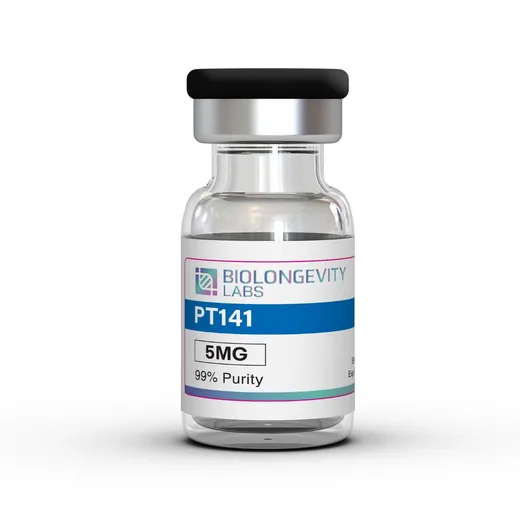
Research use only. Not for human consumption.
$21.97 as of Nov 22, 2026. Price at merchant may differ.
View research listingEducational content from an executive health coach, written as "what I would do if I were you" guidance — not medical advice, diagnosis or treatment. Injectable products sold on this site are for research use only and are not for human consumption. Talk with your licensed clinician before changing any protocol. Last reviewed November 2026.
