
Selank
Also known as: N-Acetyl Selank Amidate · NA-Selank · Tuftsin analog
A synthetic tuftsin-analog peptide studied for anxiety, stress responses, and cognitive effects; commonly discussed as an intranasal nootropic.
Selank is a synthetic heptapeptide, Thr-Lys-Pro-Arg-Pro-Gly-Pro, derived from the immune peptide tuftsin. It was developed in Russia as a peptide with proposed anxiolytic and cognitive effects, and is commonly described as a nootropic peptide. The original formulation has been used as intranasal drops; practitioner sources also discuss subcutaneous use and an amidated derivative, N-acetyl Selank amidate. These forms should not be assumed to have equivalent pharmacokinetics or evidence. Selank is not a conventional small-molecule sedative, and its proposed actions span stress-response signaling, neurotransmission, and immune-peptide biology.
Human research is concentrated in Russian clinical literature, including studies of anxiety-related symptoms and anxiety disorders using intranasal Selank. Published reports describe changes in anxiety measures and emotional symptoms, but the accessible literature is less extensive than the large, independently replicated trial programs available for established anxiolytic medicines. Animal studies report effects on anxiety-like behavior and changes in monoamine and neurotrophic signaling. Claims about memory, attention, or brain-derived neurotrophic factor (BDNF) are drawn from a mix of preclinical work and broad nootropic summaries; they should not be mistaken for proof of a defined cognitive benefit in healthy adults.
In practice, Selank is discussed as a short-term or cycling intranasal nootropic, especially when the intended effect is calm focus rather than stimulation. The Handbook groups Selank with Semax, Cerebrolysin, and Cortexin as nootropic peptides, associating the group with sharper cognition, reaction time, memory, and reduced anxiety. Jay Campbell’s practitioner protocols also describe intranasal and subcutaneous use, including cycling schedules. These are practitioner-reported approaches, not a single standardized clinical protocol. Selank is sometimes paired with Semax, but trying each separately first helps distinguish individual effects and tolerability.
@SupplementGraveyard review
Subscribe to @SupplementGraveyard to catch it on release.
What it is studied for
Russian clinical studies have evaluated intranasal Selank in people with anxiety-related symptoms and anxiety disorders, reporting improvements on symptom measures. The evidence base is smaller and less independently replicated than that for standard anxiolytic treatments.
Preclinical models report reduced anxiety-like behavior and changes in monoamine and stress-response signaling after Selank exposure.
Animal studies and molecular research report effects on learning-related measures and neurotrophic signaling, including BDNF-associated pathways; these findings do not establish a cognitive effect in healthy human users.
Practitioner accounts describe reduced anxiety while remaining alert. This is an experiential claim rather than a quantified result from a large controlled trial.
How it works
Selank’s sequence incorporates the tuftsin motif, and laboratory research proposes effects on enkephalin-degrading enzymes, thereby influencing endogenous opioid-peptide signaling. Preclinical studies also report modulation of GABAergic and monoaminergic systems, including serotonin and dopamine pathways, alongside changes in expression of genes related to stress response and neurotrophic signaling. These findings offer plausible routes to anxiolytic-like and cognitive effects, but Selank does not have one established receptor target comparable to a conventional receptor-selective drug. Intranasal delivery is intended to provide access to the central nervous system; the degree of human brain exposure and the contribution of each proposed pathway remain incompletely characterized.
Protocols used in studies & practitioner literature
Informational only. These are protocols reported in published studies, product labels and practitioner references, listed so you can read the research intelligently. They are not dosing instructions. Injectable products on this site are research-use-only.
- Dose
- 750–1,000 mcg total daily; some users report responding to 250 mcg intranasally
- Frequency
- Daily, split into doses
- Timing
- During the day
- Cycle
- 12 weeks on, 4 weeks off
- Route
- Intranasal
- Dose
- Begin at 300 mcg daily; adjust by 100–250 mcg every few days, up to 1,000 mcg/day
- Frequency
- Daily; split doses above 300 mcg/day
- Timing
- Morning is commonly used
- Cycle
- 12 weeks on, 4 weeks off
- Route
- Subcutaneous injection
- Dose
- 1 mg
- Frequency
- 2–3 days per week
- Timing
- Morning
- Cycle
- 8 weeks on, 8 weeks off
- Route
- Subcutaneous injection
- Dose
- 250–600 mcg
- Frequency
- Daily or as needed
- Timing
- As needed during the day
- Cycle
- 4 days on, 4 days off
- Route
- Intranasal or subcutaneous, as described in practitioner summaries
When and how it is used
- The practitioner references describe intranasal dosing split across the day; morning use is commonly reported for subcutaneous protocols. These schedules are not interchangeable with a standardized prescription label.
- The Russian intranasal product is described as a 0.15% drop formulation. Confirm the concentration and delivered amount per drop or spray on the specific product rather than estimating from a different formulation.
- Track anxiety, alertness, sleep, mood, and any nasal irritation or injection-site reaction. Record other stimulants, sedatives, and nootropics used so changes can be interpreted.
- Do not infer a reconstitution volume or dose-per-syringe from a vial label alone; concentration depends on the product and diluent. Follow product-specific pharmacy or clinician instructions, and do not use a product with uncertain sterility.
- Effects are described as potentially noticeable within a dosing period in practitioner accounts, while clinical studies have generally assessed symptoms over a treatment course. There is no established universal onset time or storage period across formulations.
Synergies and stacks
Considerations and cautions
- Selank and N-acetyl Selank amidate are not FDA-approved medicines in the United States; products sold as injectable peptides on this site are research-use-only. Intranasal and injectable products may have different formulation, dose-delivery, and quality characteristics.
- Human safety data are limited compared with established medicines. Reported or plausible adverse effects include nasal irritation, headache, dizziness, fatigue, and injection-site reactions; reliable rates are not available.
- People using psychiatric medicines, sedatives, stimulants, or other centrally acting drugs should seek clinician review before use because interaction data are sparse. Avoid use during pregnancy or breastfeeding unless a qualified clinician specifically directs otherwise.
- Research-vendor products may have uncertain identity, concentration, sterility, or storage history. A vial intended for laboratory research is not an approved sterile medication.
The Handbook take
The Handbook places Selank in its nootropic-peptide group with Semax, Cerebrolysin, and Cortexin. It describes the group as supporting sharper brain function, reaction time, memory, reduced anxiety, and higher BDNF, and also lists Selank in its personal nootropics routine. It does not provide a Selank-specific dosing schedule in the Handbook.
Frequently asked questions
What is a commonly reported Selank dose?
Practitioner references describe 750–1,000 mcg intranasally per day, split into doses, or subcutaneous dosing beginning around 300 mcg/day and titrating up to 1,000 mcg/day. These are reported protocols, not a standardized prescription dose.
How long does Selank take to work?
Practitioner accounts describe effects during a dosing period, while clinical studies evaluate symptoms over a course of treatment. A consistent onset time has not been established across products and routes.
What side effects can Selank cause?
Reported or plausible effects include nasal irritation, headache, dizziness, fatigue, or injection-site reactions. Human safety data are limited, so new or significant symptoms warrant stopping use and seeking medical advice.
Is Selank better orally, nasally, or by injection?
Intranasal drops are the established Russian formulation described in clinical literature, while subcutaneous use is mainly reported in practitioner protocols. Oral use is not a commonly characterized route, and route-specific doses should not be treated as equivalent.
Can Selank be stacked with Semax?
Practitioner sources discuss the pairing, and the Handbook places both in its nootropic group. Try each separately before combining them so effects and adverse reactions are easier to identify.
Is Selank legal, and will it show on a drug test?
Regulatory status varies by country; Selank is not an approved US medicine, and research-vendor products are not approved for human use. It is not a standard target on routine drug screens, but no testing outcome can be guaranteed.
Sourcing
Related entries
Research supply
BioLongevity Labs products for laboratory research, available to buy now. BioLongevity Labs takes the order and ships it; these listings are separate from the educational material. Affiliate disclosure: BioLongevity Labs links and code JASONJOHNS (15% off eligible orders) are affiliate links and a paid code; NexGen may earn a commission at no extra cost to you if you buy through them.
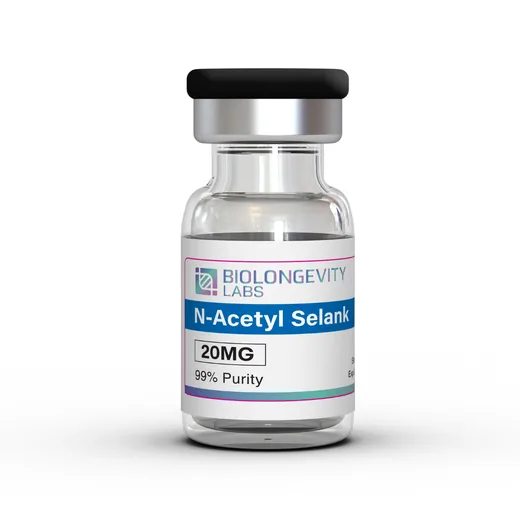
Research use only. Not for human consumption.
$126.97 as of Nov 22, 2026. Price at merchant may differ.
View research listingEducational content from an executive health coach, written as "what I would do if I were you" guidance — not medical advice, diagnosis or treatment. Injectable products sold on this site are for research use only and are not for human consumption. Talk with your licensed clinician before changing any protocol. Last reviewed November 2026.
