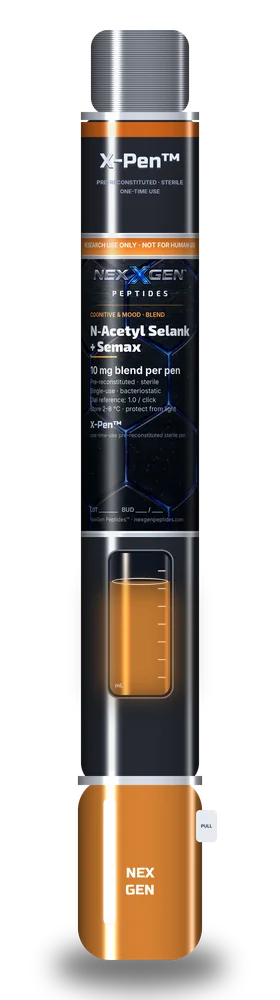
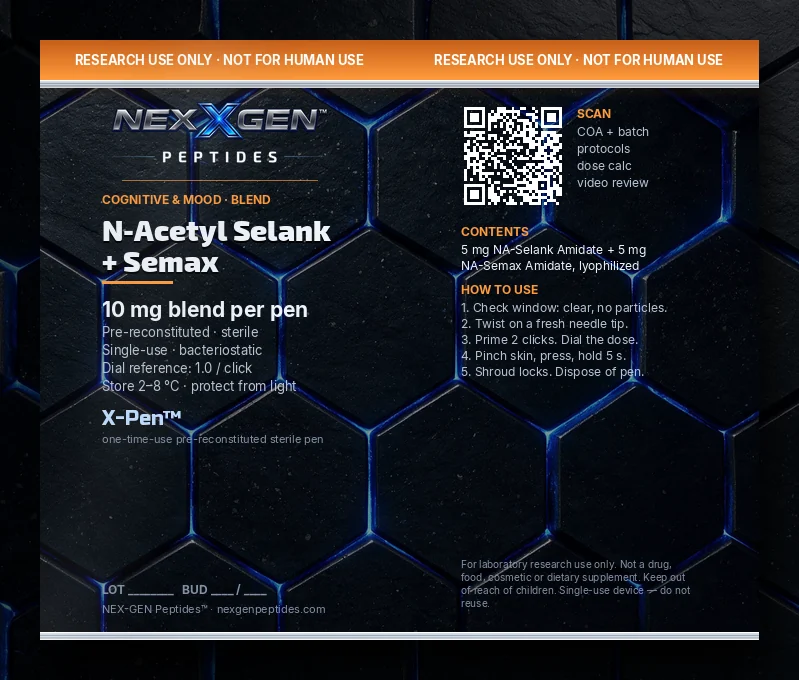
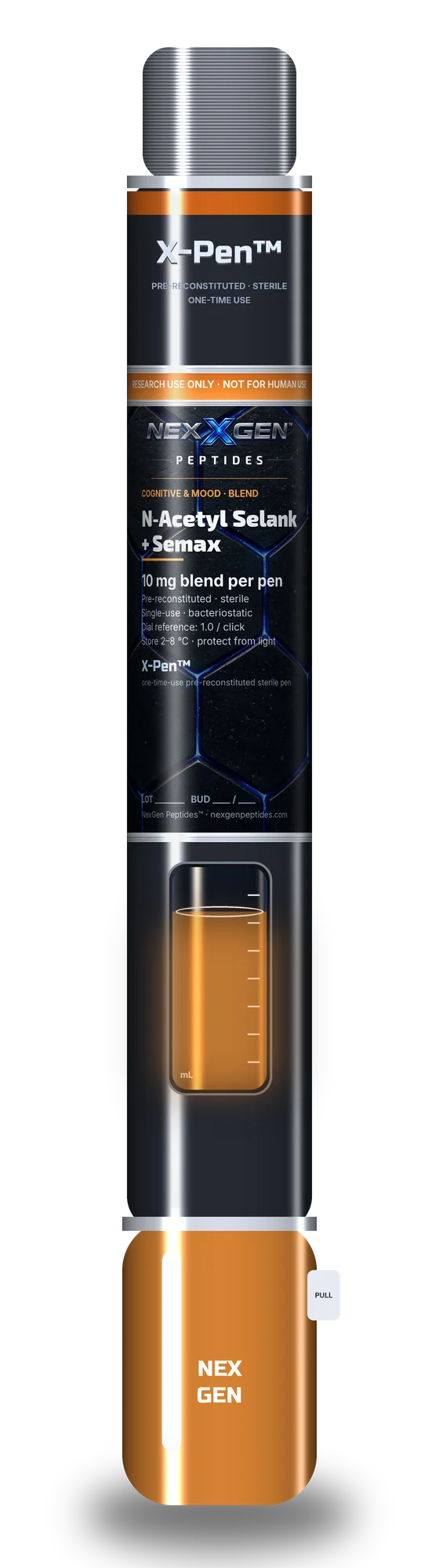
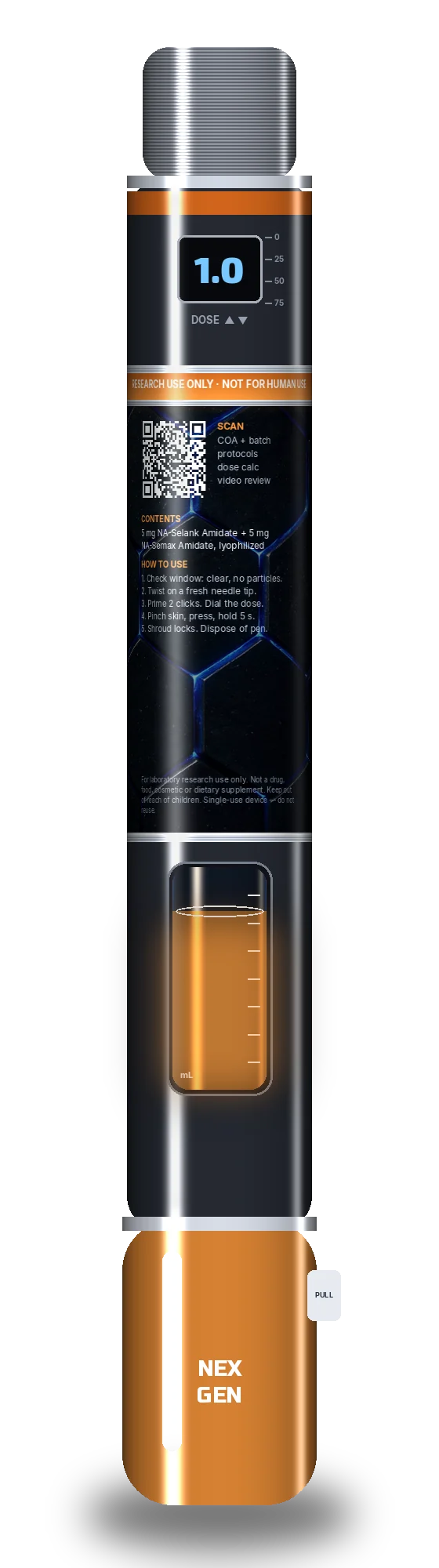
N-Acetyl Selank + Semax Blend
Also known as: NA-Selank Amidate + NA-Semax Amidate · Focus & calm blend
A research-use-only combination of amidated Selank and Semax discussed for calm focus, anxiety-related symptoms, and cognitive support.
N-Acetyl Selank + Semax Blend combines amidated derivatives of two synthetic peptides discussed in Russian and practitioner nootropic literature. Selank is a tuftsin-derived heptapeptide analog associated with anxiety and stress-response research; Semax is an ACTH-fragment-derived peptide studied for neurotrophic and cognitive effects. Amidation is a chemical modification intended to alter peptide stability, but the blend name alone does not identify the exact ratio, concentration, excipients, or delivered dose. Those product-specific details matter: protocols for each peptide cannot automatically be converted into a reliable combined dose.
Research on the blend itself is much more limited than research on the individual compounds. Selank clinical reports focus largely on intranasal use in anxiety-related populations, while Semax has been studied in Russian clinical settings including stroke recovery and in preclinical models of neurotrophic signaling. The available literature does not establish that combining the two improves outcomes beyond either compound alone. The Jay Campbell reference describes protocols for both amidate forms and explicitly advises testing each compound alone before blending; it also describes nasal spray equivalents without establishing a universal product concentration.
In practice, the combination is presented as an experimental focus-and-calm pairing rather than a standardized clinical product. The Handbook discusses Selank and Semax within its nootropic-peptide grouping and lists them together in a personal nootropics routine, but provides no specific blend dose. Jay Campbell’s practitioner reference reports an intermittent morning subcutaneous schedule and a lower daily or as-needed schedule, as well as nasal dosing equivalents. Because blend ratios vary, a total blend amount cannot be assumed to equal a given amount of either active peptide.
@SupplementGraveyard review
Subscribe to @SupplementGraveyard to catch it on release.
What it is studied for
Human clinical reports exist for Selank as an individual intranasal peptide in Russian anxiety-related settings. They do not establish efficacy for the Selank–Semax blend.
Preclinical Semax research reports changes in neurotrophic signaling and learning-related outcomes. These findings concern Semax rather than the combined amidated product.
Practitioner descriptions position the combination as a calm-focus stack. Controlled human outcome data for the exact blend are lacking.
Semax has been evaluated in Russian clinical contexts involving stroke recovery, but those studies do not test this blend or establish an additive effect with Selank.
How it works
The blend combines two peptides with distinct proposed biology. Selank is a tuftsin analog studied for modulation of enkephalin degradation, GABAergic and monoaminergic signaling, and stress-response pathways. Semax is derived from the ACTH(4–10) sequence with additional amino acids and is associated in preclinical work with BDNF, NGF, dopaminergic signaling, and plasticity-related pathways. These mechanisms are not established as a single combined pathway, and human studies have not defined a synergistic receptor interaction. A product’s amidation and peptide ratio may alter stability and exposure, so evidence on unmodified individual peptides does not fully characterize a specific blend.
Protocols used in studies & practitioner literature
Informational only. These are protocols reported in published studies, product labels and practitioner references, listed so you can read the research intelligently. They are not dosing instructions. Injectable products on this site are research-use-only.
- Dose
- 1 mg
- Frequency
- 2–3 days per week
- Timing
- Morning
- Cycle
- 8 weeks on, 8 weeks off
- Route
- Subcutaneous injection
- Dose
- 250–600 mcg
- Frequency
- Daily or as needed
- Timing
- During the day
- Cycle
- 4 days on, 4 days off
- Route
- Route depends on the specific product; practitioner reference describes this schedule for the amidate forms
- Dose
- 300 mcg per spray equivalent
- Frequency
- Product-dependent
- Timing
- As directed by the product protocol
- Cycle
- No separate cycle stated for nasal spray equivalent
- Route
- Intranasal
When and how it is used
- Confirm the blend ratio and the amount of each peptide per spray or vial; a stated total blend dose does not reveal the Selank and Semax doses separately.
- The reference recommends testing each compound alone before blending. This can help identify which peptide is associated with a benefit or adverse effect.
- Morning use is described in the intermittent subcutaneous practitioner schedule. The blend has no established standardized timing relative to meals, sleep, or training.
- Record focus, anxiety, mood, sleep, headache, nasal irritation, and injection-site effects. Avoid changing several nootropics at once if the goal is to assess the blend.
- Do not calculate reconstitution volume or dose per syringe without a verified product concentration and product-specific sterile-use instructions. Storage and beyond-use periods vary by formulation; follow pharmacy instructions rather than assuming a general peptide storage rule.
Synergies and stacks
Considerations and cautions
- This exact blend has no established standardized clinical formulation or dosing label. The ratio, concentration, sterility, and stability can differ across research-vendor products.
- N-acetyl Selank and amidated Semax products sold as injectable peptides are research-use-only and are not approved US medicines. Intranasal and injectable formulations are not interchangeable.
- Potential effects include nasal irritation, headache, dizziness, fatigue, or injection-site reactions; safety and interaction data for the combined product are sparse. Review use with a clinician, particularly when taking psychiatric or other centrally acting medicines.
- Products from unverified sources may contain the wrong peptide, concentration, or contaminants. Do not use products without reliable identity, sterility, and storage documentation.
The Handbook take
The Handbook does not give a dedicated entry or dosing protocol for this blend. It groups Selank and Semax with Cerebrolysin and Cortexin as nootropic peptides and lists Selank and Semax together in its personal nootropics routine. Its general description associates the group with cognition, reaction time, memory, and reduced anxiety.
Frequently asked questions
What is the reported dose of the Selank–Semax blend?
Jay Campbell’s practitioner reference reports 1 mg subcutaneously in the morning 2–3 days weekly for 8 weeks on and 8 weeks off, and a 250–600 mcg daily or as-needed schedule with a 4-on/4-off cycle. The blend ratio must be confirmed because total blend mass does not specify each peptide dose.
How soon might the blend affect focus or anxiety?
Practitioner accounts describe effects during use, but controlled trials have not established an onset time for the combined amidated product. Track each component separately before interpreting a response to the blend.
What are possible side effects?
Possible effects include nasal irritation, headache, dizziness, fatigue, or injection-site reactions. The exact blend has limited human safety information, so stop and seek medical advice for significant symptoms.
Should Selank and Semax be tested separately first?
Yes. Jay Campbell’s reference specifically advises trying each compound alone before blending, which makes individual tolerability and effects easier to assess.
Can this blend be used intranasally or by injection?
Practitioner references describe both intranasal and subcutaneous use, but formulations and delivered doses differ. A nasal spray’s concentration and a vial’s blend ratio must be verified rather than assumed equivalent.
Is the blend legal or detectable on a drug test?
Regulatory status varies, and these research-use-only products are not approved US medicines. They are not standard targets on routine drug screens, but no testing result is guaranteed.
Sourcing
Related entries
Educational content from an executive health coach, written as "what I would do if I were you" guidance — not medical advice, diagnosis or treatment. Injectable products sold on this site are for research use only and are not for human consumption. Talk with your licensed clinician before changing any protocol. Last reviewed November 2026.