
Reviews Bioregulators Pancreatic Tissue
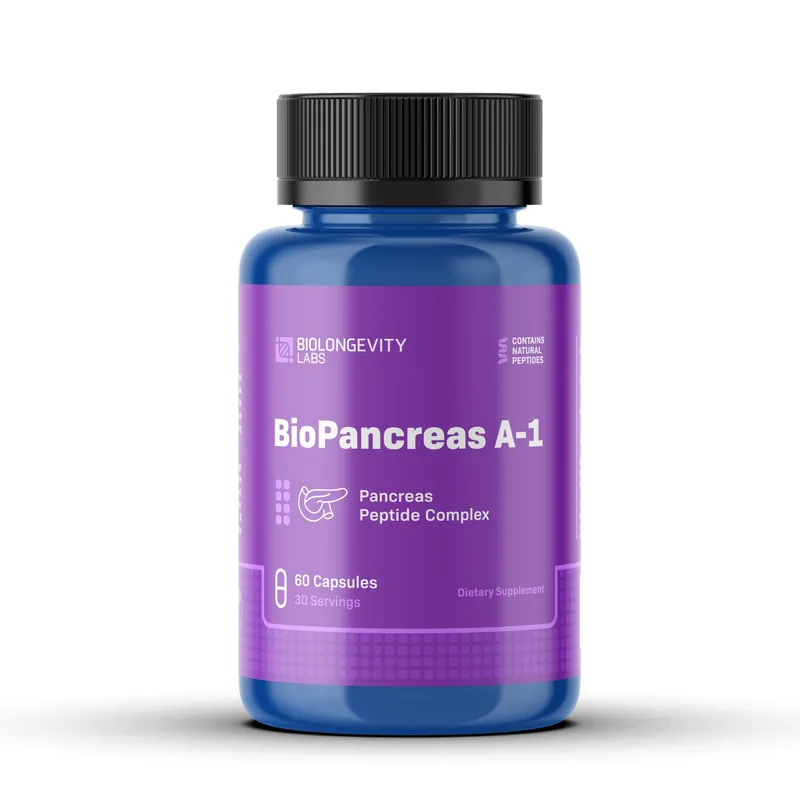
BioPancreas
Also known as Suprefort, A-1
A Suprefort-labeled pancreatic peptide extract. The stronger research applies to synthetic Pancragen, not the A-1 capsule.
- Advanced (draft)
- Compound evidence D · In vitro / mechanistic only
- Researched, not personally tested
- capsule
- Rank pending
Grades describe published research on the compound, not this product.
What it is
BioPancreas is an oral complex of peptides from young-animal pancreatic tissue. Suprefort is the A-1 mixture; Pancragen is the four-residue KEDW sequence from a related research program.
What it has been studied for
Differentiation markers in pancreatic cells
In vitroSynthetic Pancragen changed differentiation markers in aging pancreatic cultures. That directly tests KEDW-class material rather than the Suprefort mixture.
Glucose response with historical Pancragen
Human (small / observational)A small older human study reported changes in fasting glucose and insulin-related indicators with Pancragen. It did not investigate this A-1 preparation or establish a reliable supplement effect.
Exocrine digestive enzymes
MechanisticBLL places digestive-enzyme activity alongside endocrine metabolism in its A-1 description. No product-specific data verify improved enzyme output or digestion.
This study examined the research compound, not the product sold by BioLongevity Labs. The findings do not establish that the product is safe or effective for people.
Research contexts
- Comparing a pancreatic glandular extract with synthetic KEDW
- Separating exocrine digestive endpoints from blood-glucose endpoints
Cautions & unknowns
- Do not use it in place of prescribed glucose control or pancreatic enzyme therapy.
- BioLongevity Labs designates this product for in vitro research use only. Not for human or veterinary administration.
Jason’s take
Jason's hands-on review is coming.
Handbook §25 “The Ultimate Guide to Peptides”: Provides background on the Khavinson bioregulator family; this is not a direct mention or personal-use record of the specific product.
Compared products
One product reviewed so far. Comparison slots stay empty until Jason chooses alternatives.
- Product 1
BioLongevity Labs
BioPancreas – A-1 Pancreas Peptide Bioregulator (Suprefort)
SKU BR-A1 · 20 capsules, 60 capsules
Researched, not personally tested
Where it shines
- Labels the pancreatic A-1 mixture separately from the company’s Pancragen research vial.
- The 20- and 60-capsule listings span $62.97 to $154.97. At those two listed prices, that is $3.15 and $2.58 per capsule, respectively.
Where it falls short
- The listing does not establish either digestive enzyme activity or glucose effects for the actual capsule.
- The listing describes a peptide complex, not a sequence-by-sequence assay; its total mass is not a measure of absorbed peptide.
Verdict: A pancreatic extract whose clinical case cannot be borrowed from Pancragen.
$62.97–$154.97 as of Nov 22, 2026 at BioLongevity Labs
For in vitro research use only. Not for human or animal use.
Related reviews
Sources
- BioPancreas – A-1 Pancreas Peptide Bioregulator (Suprefort) product listing BioLongevity Labs · accessed Nov 22, 2026
- Peptide Bioregulators: Types, Uses, and Side Effects Jay Campbell · accessed Nov 22, 2026
- Short peptides and differentiation markers in aging cell cultures PubMed · accessed Nov 22, 2026
- Indexed research record (PMID 22448364) PubMed · accessed Nov 22, 2026
Updated Nov 22, 2026. Written by the NexGen research team for @SupplementGraveyard™. Jason Johns is an executive health coach, not a licensed healthcare provider. This content is educational only and does not create a provider-patient relationship.