
Reviews Bioregulators Airway Tissue
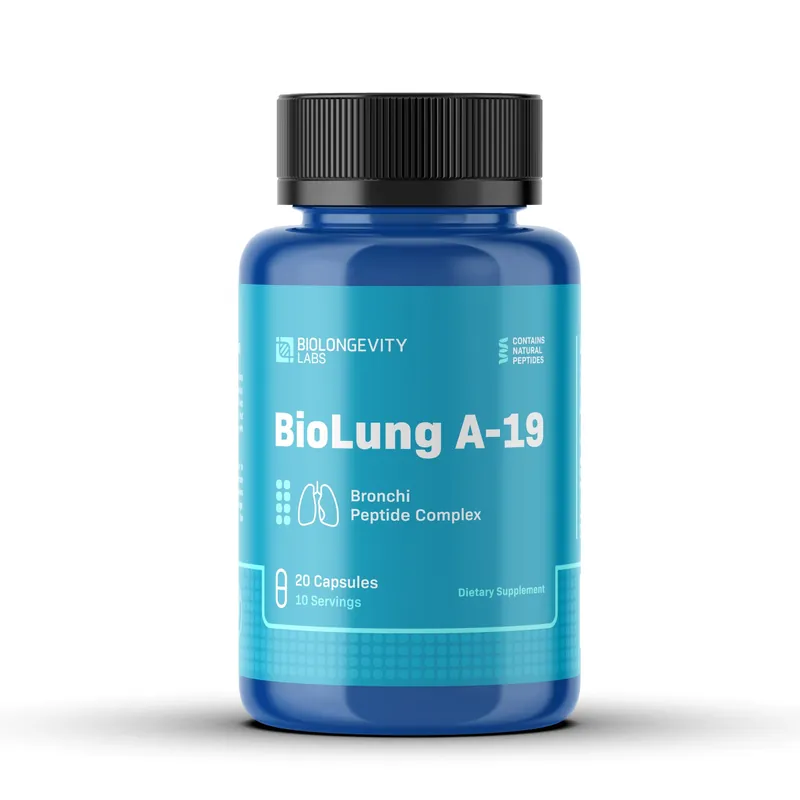
BioLung
Also known as Taxorest, A-19
An A-19 bronchial mucosa extract labeled Taxorest, distinct from the synthetic airway peptide Bronchogen tested in cells and rats.
- Advanced (draft)
- Compound evidence D · In vitro / mechanistic only
- Researched, not personally tested
- capsule
- Rank pending
Grades describe published research on the compound, not this product.
What it is
BioLung is an oral peptide mixture BLL says is sourced from young-animal bronchial mucosa. Its Taxorest designation refers to an extract-type product, not the defined Bronchogen or Chonluten sequence.
What it has been studied for
Bronchial epithelial differentiation markers
In vitroSynthetic Bronchogen changed differentiation markers in aging bronchial epithelial cultures. The investigators did not test Taxorest or measure respiratory function in people.
Airway epithelial structure in rats
AnimalA rat study examined bronchial epithelial changes with a related defined peptide. The findings cannot establish that an oral A-19 extract changes airway function.
Mucosal resilience and duration claims
MechanisticBLL describes bronchial mucosal support and a possible lasting effect. The catalog does not provide a human A-19 study with lung-function endpoints and follow-up.
This study examined the research compound, not the product sold by BioLongevity Labs. The findings do not establish that the product is safe or effective for people.
Research contexts
- Comparing a bronchial extract with defined synthetic airway peptides
- Tracking the difference between histology and measured lung function
Cautions & unknowns
- Not a replacement for prescribed inhalers or assessment of persistent respiratory symptoms.
- BioLongevity Labs designates this product for in vitro research use only. Not for human or veterinary administration.
Jason’s take
Jason's hands-on review is coming.
Handbook §25 “The Ultimate Guide to Peptides”: Provides background on the Khavinson bioregulator family; this is not a direct mention or personal-use record of the specific product.
Compared products
One product reviewed so far. Comparison slots stay empty until Jason chooses alternatives.
- Product 1
BioLongevity Labs
BioLung – A-19 Lung Peptide Bioregulator (Taxorest)
SKU BR-A19 · 20 capsules, 60 capsules
Researched, not personally tested
Where it shines
- Identifies bronchial mucosa, rather than unspecified whole lung, as the source described by BLL.
- The 20- and 60-capsule listings span $74.97 to $154.97. At those two listed prices, that is $3.75 and $2.58 per capsule, respectively.
Where it falls short
- Bronchogen and Chonluten studies cannot verify the composition or action of Taxorest.
- The listing describes a peptide complex, not a sequence-by-sequence assay; its total mass is not a measure of absorbed peptide.
Verdict: The airway research is largely about other molecules, not BLL’s Taxorest-labeled capsules.
$74.97–$154.97 as of Nov 22, 2026 at BioLongevity Labs
For in vitro research use only. Not for human or animal use.
Related reviews
Sources
- BioLung – A-19 Lung Peptide Bioregulator (Taxorest) product listing BioLongevity Labs · accessed Nov 22, 2026
- Peptide Bioregulators: Types, Uses, and Side Effects Jay Campbell · accessed Nov 22, 2026
- Short peptides and differentiation markers in aging cell cultures PubMed · accessed Nov 22, 2026
- Indexed research record (PMID 26468022) PubMed · accessed Nov 22, 2026
Updated Nov 22, 2026. Written by the NexGen research team for @SupplementGraveyard™. Jason Johns is an executive health coach, not a licensed healthcare provider. This content is educational only and does not create a provider-patient relationship.