
Reviews Bioregulators Cardiac Tissue
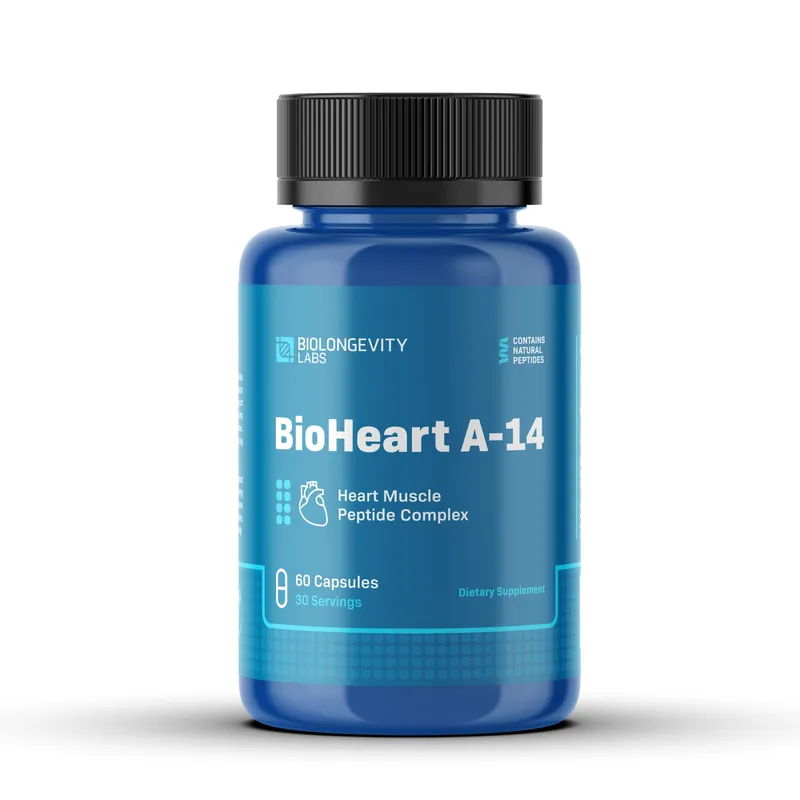
BioHeart
Also known as Chelohart, A-14
A Chelohart-labeled cardiac muscle extract. Related Cardiogen studies used defined peptides in cell and tissue cultures, not this oral formula.
- Advanced (draft)
- Compound evidence D · In vitro / mechanistic only
- In the Handbook of Health
- capsule
- Rank pending
Grades describe published research on the compound, not this product.
What it is
BioHeart is the A-14 complex of natural fractions BLL says it obtains from young-animal cardiac muscle. It is separate from both the aortic BioBloodVessels extract and the defined AEDR peptide Cardiogen.
What it has been studied for
Myocardial explant response to Cardiogen
In vitroResearchers studied heart explants from young and old rats and reported a growth response with synthetic Cardiogen. An explant response does not measure heart performance or prove Chelohart activity.
Cellular aging in cardiovascular tissue
MechanisticA review discusses senescent cardiovascular cells and potential peptide effects. It provides mechanistic background, not a clinical study of BioHeart.
Cardiac metabolism and function claims
MechanisticBLL discusses metabolism and maintenance of myocardium. The catalog does not identify a clinical test of this product measuring heart function or exercise capacity.
This study examined the research compound, not the product sold by BioLongevity Labs. The findings do not establish that the product is safe or effective for people.
Research contexts
- Comparing myocardial extract and AEDR research
- Separating tissue-culture growth from cardiac endpoints
Cautions & unknowns
- No evidence here supports managing blood pressure, heart failure, or recovery from a cardiac event with the capsule.
- BioLongevity Labs designates this product for in vitro research use only. Not for human or veterinary administration.
Jason’s take
Jason's hands-on review is coming.
Handbook §25, The Ultimate Guide to Peptides. The Handbook names Chelohart as a heart-associated preparation; no exact SKU use is documented.
Handbook §25 “The Ultimate Guide to Peptides”: The Handbook names Chelohart as a heart-associated preparation; no exact SKU use is documented.
Compared products
One product reviewed so far. Comparison slots stay empty until Jason chooses alternatives.
- Product 1
BioLongevity Labs
BioHeart – A-14 Heart Peptide Bioregulator (Chelohart)
SKU BR-A14 · 20 capsules, 60 capsules
In the Handbook of Health
Where it shines
- The label makes the distinction between cardiac muscle and aortic tissue sourcing clear.
- The 20- and 60-capsule listings span $62.97 to $154.97. At those two listed prices, that is $3.15 and $2.58 per capsule, respectively.
Where it falls short
- An organ source and a product name are not a validated assay of cardiac activity.
- The listing describes a peptide complex, not a sequence-by-sequence assay; its total mass is not a measure of absorbed peptide.
Verdict: A clearly labeled myocardial extract, but it has no verified clinical cardiac benefit.
$62.97–$154.97 as of Nov 22, 2026 at BioLongevity Labs
For in vitro research use only. Not for human or animal use.
Related reviews
Sources
- BioHeart – A-14 Heart Peptide Bioregulator (Chelohart) product listing BioLongevity Labs · accessed Nov 22, 2026
- Peptide Bioregulators: Types, Uses, and Side Effects Jay Campbell · accessed Nov 22, 2026
- Organotypic rat tissue cultures and four synthetic peptides PubMed · accessed Nov 22, 2026
- Indexed research record (PMID 36611900) PubMed · accessed Nov 22, 2026
Updated Nov 22, 2026. Written by the NexGen research team for @SupplementGraveyard™. Jason Johns is an executive health coach, not a licensed healthcare provider. This content is educational only and does not create a provider-patient relationship.